Category Archives: General

Dog and Cat Meat and Fur Trade Around The World

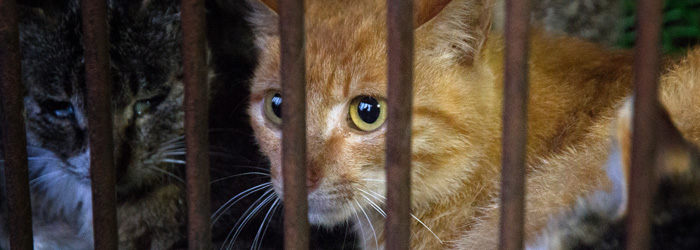
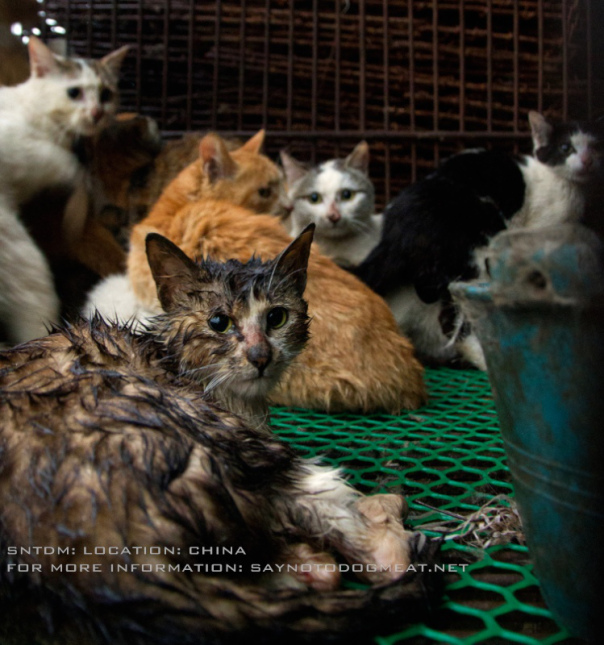
Cat trade

The dog and cat meat trade is a multi-billion dollar industry that exists all over Asia and in Hawaii, Mexico, the Arctic and Antarctic, more than twenty countries in Africa and parts of India. Worldwide, it is estimated that more than 30 million dogs are killed and eaten every year, primarily in Asia.

China has a long history of eating dogs and the dog and cat meat and fur trade is more prevalent in China than anywhere else in the world, and it is estimated that 15 million dogs and cats are eaten there annually. Some figures say 18 million which is about 50,000 per day. Even so, dog and cat meat is not part of mainstream Chinese culInary culture and in a 2016 poll, 70% claimed they had never eaten it.

Yulin is a 10-day long festival held in the city of the same name in southern China celebrating the summer solstice where 10,000 dogs and cats are killed and eaten every year. Far from being ancient or traditional, Yulin was created recently in 2009 to bring business to a place which had been economically depressed and it has been successful in doing so. What many do not realise is that Yulin happens all year round, all over the Chinese countryside. Yet we are led to believe that dog meat farms do not exist in China but, while they may be mostly on a fairly small scale, sadly they do.

Countries that rely heavily on Western tourism, including Indonesia, Vietnam, Laos and Thailand, often attempt to deny that the trade exists within their borders. While some of these countries have histories of dog eating, others only did so during times of famine, such as South Korea, which once considered eating dog shameful.

Indonesia – 1 million tortured on the street.

Cambodia does not have much of a cat meat trade and most of the dogs are trafficked by dog meat traders who exchange plastic buckets and pots and pans for village dogs. In Cambodia, dogs are traditionally eaten at celebrations such as weddings.

Philippines: Half a million dogs are slaughtered annually in the Philippines. In the capital city of Manila, the law specifically prohibits the killing and selling of dogs for food except in certain circumstances including research and animal population control. The dog meat trade there is primarily centered in the northern provinces. Historically, it was associated with celebratory events and rituals of mourning and only affected a small number of dogs. However, over the past 25 years, the dog meat trade has rapidly increased for commercial rather than cultural reasons.

Vietnam: Dog meat is eaten throughout Vietnam where at least five million dogs and one million cats are killed and eaten every year to use as food and medicine.

Taiwan: In 2017, Taiwan became the first country in Asia to outlaw the consumption of dog and cat meat. Anyone who bought or ate the meat could be fined up to around $8,000. Taiwan first made it illegal to slaughter dogs and cats and sell their meat in 1998, but the trade then went underground. Taiwan has now increased the fines and those who cause deliberate harm to a cat or dog can be fined up to $65,000, and serve two years of jail time.

South Korea is open and unapologetic about its taste for dog meat. South Korea is famous for their horrific dog farms, where dogs are bred for food in the most appalling squalor. During ‘Bokdays’, South Korea’s 60-day-long dog eating festival held annually from July through to August, approximately 15,000 dogs and several thousand cats lose their lives each day, all in the name of gastronomic pleasure and cultural superstition.

Moran Market

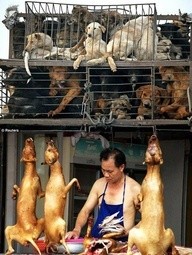
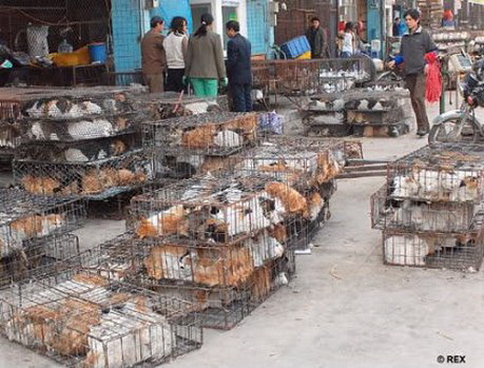
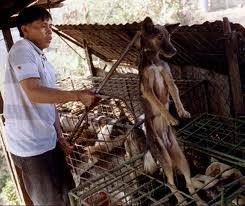
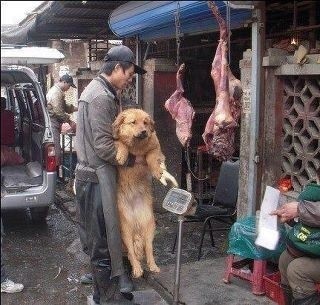
In South Korea’s live dog and cat meat markets, terrified dogs and cats are brutally slaughtered in front of diners including children who may stand and watch, seemingly unaffected as they wait for their meals or elixirs to be ‘prepared’. Typically, tourists and non-Koreans are not allowed in this market where people can pay extra to have the dog of their choice “tenderized” in the old-fashioned way or what many would call the preferred way,
Dog meat trade new 001

Dogs - Meat and skin trade 15

Dog and cat trade 7

X ScreenShot #382

No meat industry is without cruelty, however, what truly separates this meat trade from others throughout the world is the extreme level of brutality and pain that the animals suffer.

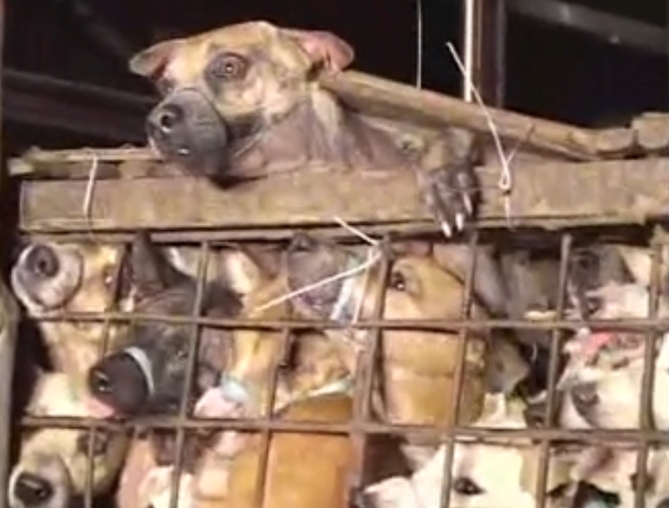
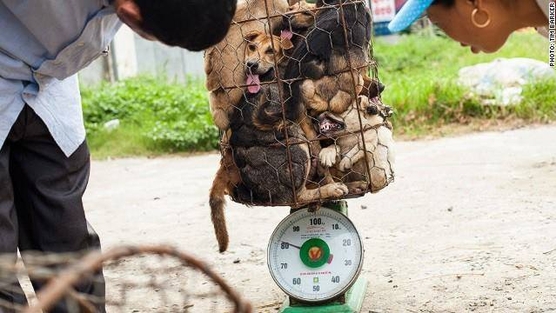
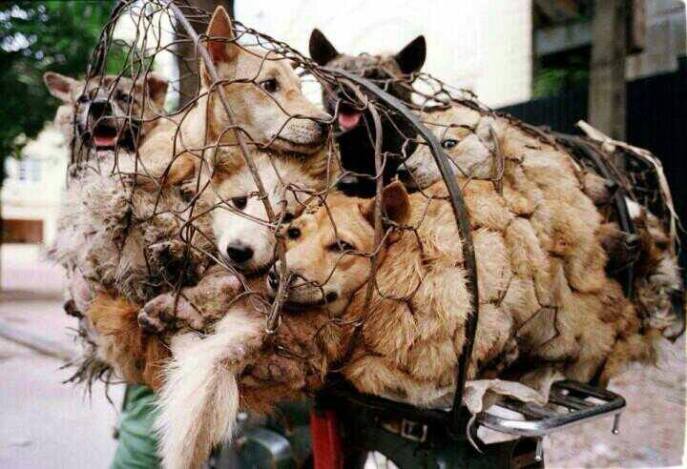
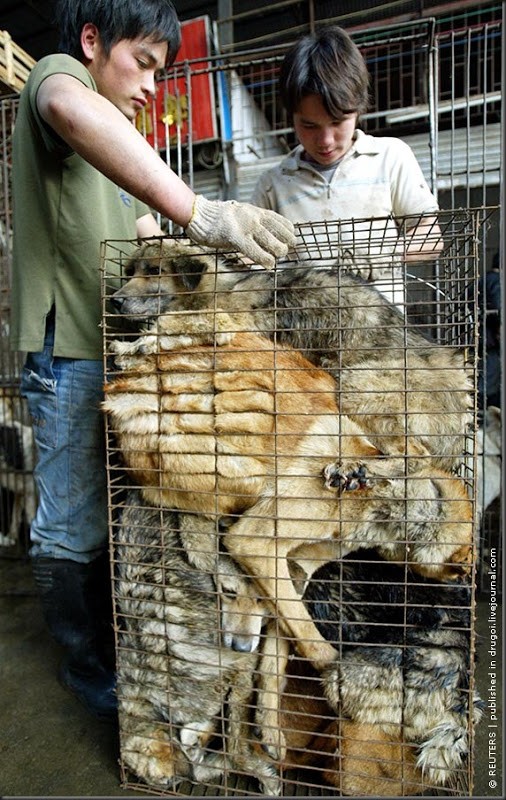
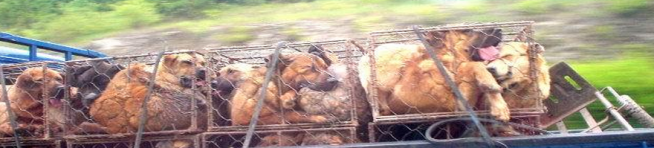
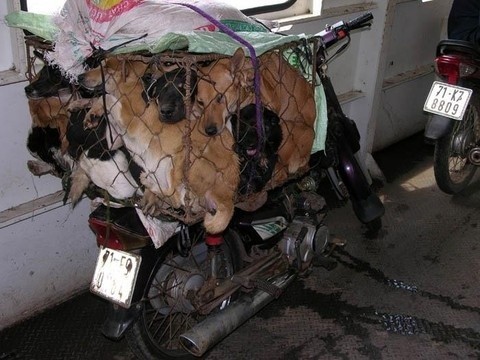
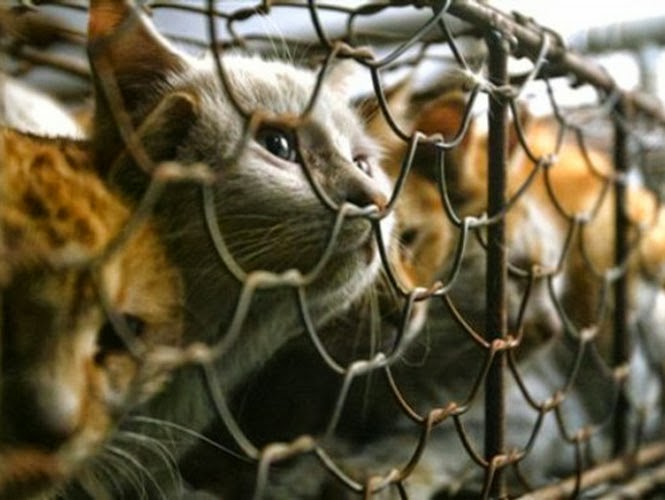
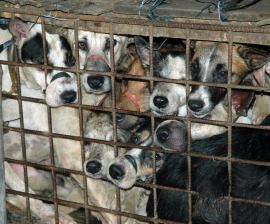
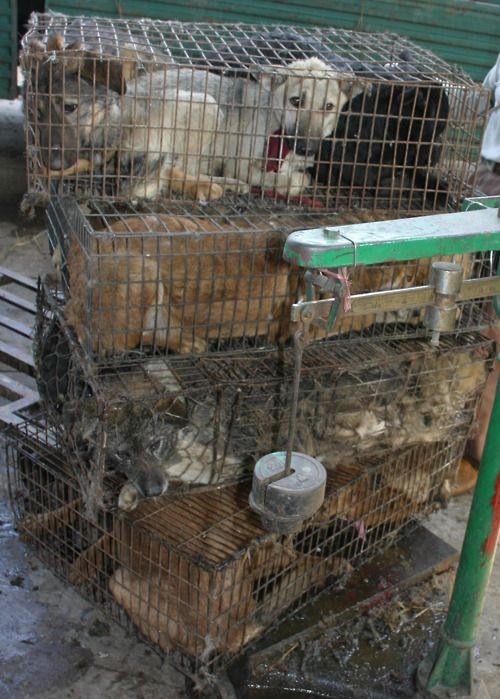
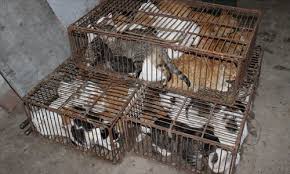
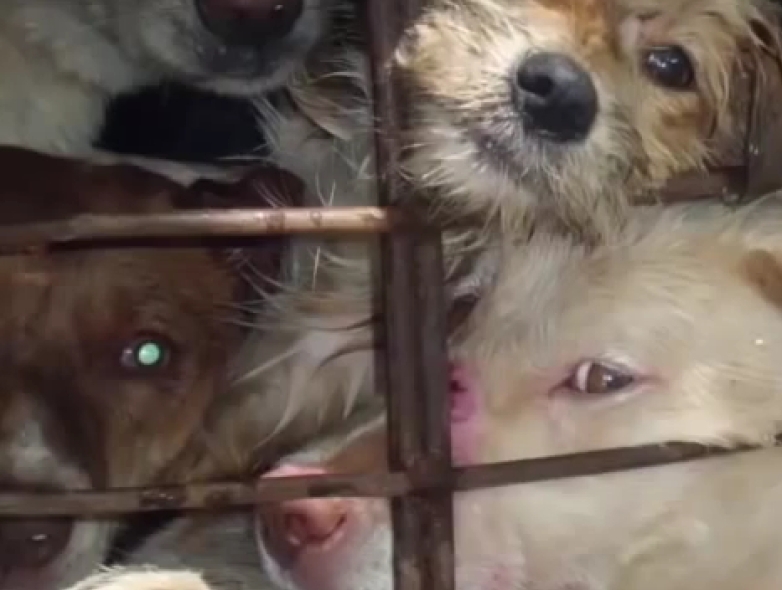
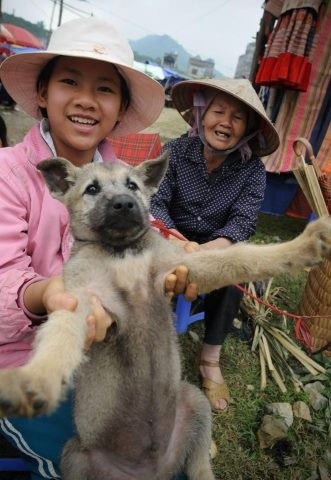
Depending on the country, many of the dogs that end up in the markets are raised specifically for their meat, while others are lost or stolen pets. Some still wear their collars and tags as they are crammed into small wire cages – sometimes twenty-five dogs in one cage – and sold to slaughterhouses by cruel traffickers. Most dog meat dealers and butchers come from a criminal element and are often members of underground gangs, which commonly operate the dog and cat meat trades in these countries.

In every country where dog meat is eaten, the people who do these things believe that the more intense the fear and torture experienced by the animals, the better flavour the meat will have.

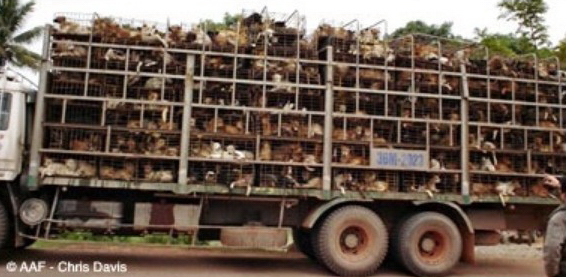
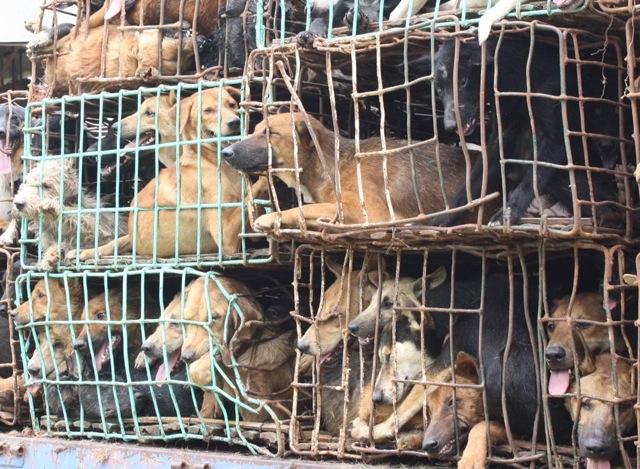
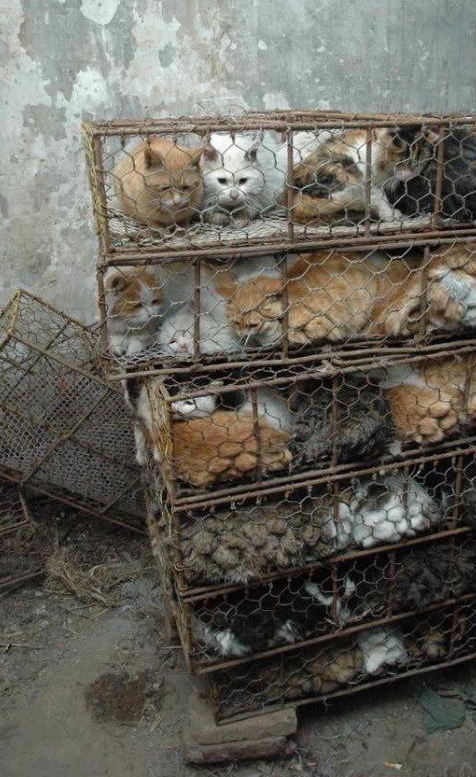
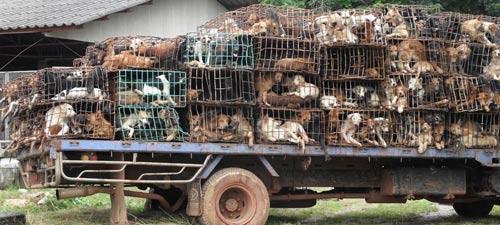
Transported on lorries often for long distances, the dogs and cats are crammed into cages so small they can’t move. They travel sometimes for days in hot or cold weather with no food or water so that many die, or else survive only to meet a brutal death at the slaughterhouse or market.

Dogs and cats are ‘tenderized’ prior to death via malicious practices including combinations of hanging, bludgeoning, stabbing, electrocuting, burning, boiling and skinning alive.

Machines are commercially available made especially to help torture and skin the animals alive with a rotating drum for the removal of their fur. To make that easier by softening their skin often they are put alive into pots of boiling water.  This is all carried out in front of the dogs waiting to be tortured and killed so that they experience the maximum terror possible.

The belief is that by stimulating as much adrenaline as possible through the animal’s body before the moment of death the meat will be more tasty and healthful.

In many cases, the dogs and cats are not given any food or water, and sometimes their food is their companions who die and then are boiled whole in a pot. Oftentimes they are fed unpalatable food just to fatten them up for slaughter and if they refuse to eat it due to traumatization it is forced down their throats through pipes in a similar way to geese force-fed for foie gras so that sometimes they choke to death or die of suffocation.
Dogs - Meat and skin trade markets 16

Dogs - Meat and skin trade markets 15

Dogs - Meat and skin trade markets 13

In China and South Korea, for example, a common superstition is that eating tough dog meat makes men strong and sexually potent. While soup made from cat meat provides health benefits, cures ailments and wards off bad luck. There is no scientific proof to support these claims and if anything, eating the meat of animals that are stressed, sick and near death due to rough handling, horrendous transport conditions and exposure to communicable diseases including rabies, is extremely deleterious to human health.

Despite the fact that it is illegal to eat dog meat in many of these countries, the dish continues to be popular due to weak law enforcement and the absence of enforceable companion animal welfare laws.
Dog and cat trade 10

Dog meat trade new 00210454331_594441667338573_4739439180975824702_n

Dogs - Meat and skin trade 04

Any dog can end up in the meat trade, former animal companions, stolen pets, purebreds such as cocker spaniels, poodles, labradors, ShihTzus, lhasa apsos, schnauzers, maltese terriers, beagles, dogs from puppy mills, shelters, farmed dogs and dogs sold at closed dog auctions.

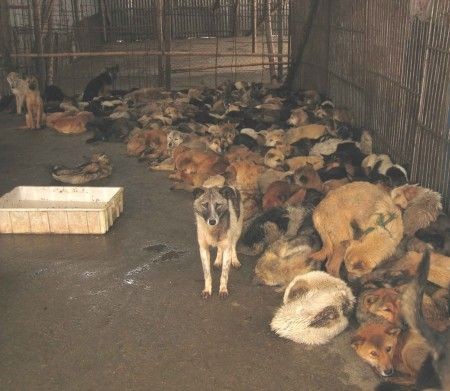
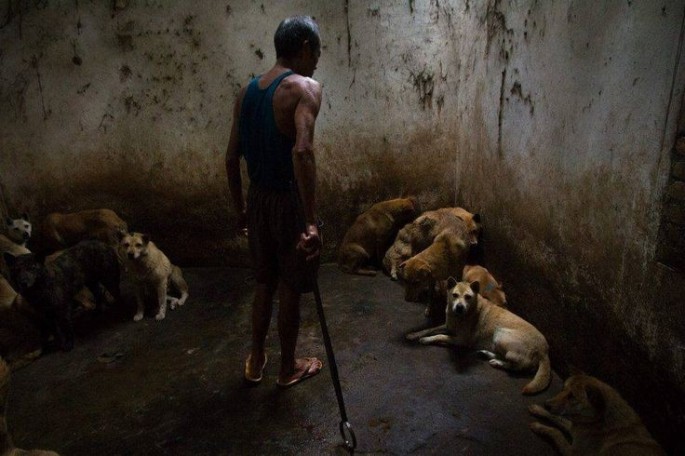
These are animals who were either street dogs, stolen pets or bred for the purpose of eating sometimes in the most appalling circumstances imaginable. The places where they are kept are filthy, cold and damp. They have no comforts whatsoever and hell, terror, pain and death is all that there is around them – what is more, much of that is intentional.

Many defend dog and cat eating as a country’s right to follow its ‘cultural tradition’. Yet throughout human history there have been numerous horribly cruel practices that have been banned as societies became more civilized and compassionate.

After all, slavery and human sacrifice were once considered ‘cultural traditions’. The ‘tradition’ of eating dog and cat meat is no different.  We believe that any country that supports or turns a blind eye to such malicious cruelty – whether toward humans or animals – has no right to call itself ‘civilized’.

Through the mission to spread global awareness, promote humane education and persuade governments to enact strict and enforceable animal welfare legislation, the vision of charities working to end this trade is that one day companion animals throughout the world will never again be victims of torture for the purposes of using them as food and in the fur and skin trade.
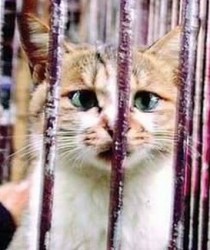
Skinned Alive – the Trade in Cat and Dog Fur

Imagine someone stealing your cat or dog and skinning it alive before it dies a slow, agonising death.

Yet, as hard as it is to imagine, this is the daily reality for over two million domestic animals every year in China.

Fuelled by the insatiable demands of a cruel and callous fashion industry, it is estimated that 20 million cats and dogs, along with 40 million other animals, are slaughtered for their fur and sold internationally.

Innocent cats and kittens are strangled and slit open while other cats watch terrified, the little kittens among them paralysed with fear trying to make themselves invisible, all awaiting the same fate.

The dogs are tethered by a wire noose, then stabbed in the groin, the lucky ones bleed to death before being skinned, while those less fortunate are skinned once blood loss renders them too weak to struggle. Some desperately try to escape in a pool of blood. This method of slaughter causes least damage to the animals’ fur, thus preserving its market value.

A recent undercover investigation by the Humane Society of the United States (HSUS) and investigative journalist Manfred Karreman exposed one of the dirtiest of the fur trade’s secrets. They followed the blood trail across three continents and filmed cats and dogs being beaten, strangled and stripped of their fur. They filmed the whole gruesome business from the Chinese slaughterhouses to the European auction houses.
Dog and cat trade meat and fur 12

In March 1999, BBC2’s Newsnight exposed a London fur company, Alaska Brokerage owned by Peter and Carol Bartfield, demonstrating that they were willing to trade in cat and dog fur – although the firm claims that it has no association with the extreme cruelty exposed by the HSUS and Karreman. The Newsnight programme further pointed out that the trade in cat and dog skins in Europe is legal and fur does not have to be labelled by species or even as real fur.

While many people know that all animals killed for their fur suffer terribly, few are aware of the grisly killing methods: the gassing, lethal injection, neck-breaking and anal electrocution. But the film of cats and dogs, collected as part of the HSUS and Karreman investigation, shows some of the most shocking footage ever shot.

As well as dogs being tied by the neck, stabbed in the groin and left to bleed to death, cats and kittens killed by being hung from a rope and strangled, investigators witnessed cats being hung by a wire noose while water was forced down their throats through a hose until they drowned. The film is silent, but it shows the animals’ extreme pain and distress as they struggle fully conscious and bleeding.
Dog meat trade new 7

“It was terrible”, recalls Karreman. “I saw a cat with her fur being ripped off its back, screaming for a whole minute. I wake up in the middle of the night sometimes and I can still hear her screaming. I still see their faces, the terror and pain in their eyes; and I hear their desperate cries”.

Following the HSUS exposé, America was outraged and the government acted immediately and outlawed the import, export and sale of products made with dog and cat fur. The US Dog and Cat Protection Act 2000 requires all fur products, however small, to be DNA tested. Violators are liable to six months imprisonment and a $10,000 fine. Unfortunately, most EU countries, particularly Britain, seem reluctant to stop this horrific trade. The US ban, however, means that more of these products are now likely to be imported into the EU and Britain.
Dog and cat trade 08

There is further concern that consumers may not be aware that the fur-trimmed clothing and accessories, stuffed animals and pet toys they are buying may be made from dog and cat fur. The Department of Trade and Industry has long been aware that ‘there is a legitimate trade in cat skins’ and last year, over 500 tonnes of fur, 66 tonnes classified as ‘other fur’ – the category under which cat and dog fur falls – was imported into the UK.

Dr Nick Palmer MP is the sponsor of an Early-Day Motion in the House of Commons which has the support of 224 cross-party MP and urges the government to follow the American precedent. At a recent Adjournment Debate in the House he spoke of the two million cats and dogs living and dying in appalling conditions each year in fur farms in the Philippines and China. He also noted that the British Fur Trade Association had promised not to deal in cat and dog fur, yet the Newsnight report had shown a “reputable member of the fur trade who was prepared systematically to mislabel cat and dog fur imports”.
Dog and cat trade 5

Mark Glover, award-winning campaign director of Respect for Animals, said they were “extremely disappointed with the government’s indifference. The US and Italy have banned such imports and the government themselves have described it as ‘abhorrent’, yet they are incapable of taking a moral position on anything”.

Alaska Brokerage’s Peter Bartfeld, formerly a director of the British Fur Trade Association, is secretive about his involvement in the fur trade. When I managed to track him at his home, after a series of failed attempts, he finally returned my call with unconcealed hostility. “I do not trade in cats and dogs”, he shouted, stuttering with fury. “And if you got your information from the animal rights people, they’re seriously misinformed. The BBC report is a completely bogus setup.”

Bartfeld has previously claimed that the cat skins they deal in come from vets and that they were already dead when acquired. A 1987 Financial Times article reported him as saying that “all European cat skins that are used in the trade come from dead animals that have been put to sleep by vets. Vets kill animals, not fur traders”.
Dog and cat trade 09

The BBC’s 1999 investigation into Alaska Brokerage’s secret activities revealed that the company was prepared to sell cat and dog pelts to anyone who was prepared to pay. BBC investigator Martin Wilson visited Alaska Brokerage and filmed Peter Bartfeld offering 10,000 ‘goupee’ (a term for dog fur) and 150,000 cat furs. Bartfeld explained that dog is labelled ‘goupee’ and cat ‘Jeanette’ or ‘Chinese cat’, adding that this deception is necessary ‘because of the sensitive nature of the fur business’. He boasted to the reporter that ‘whatever trade is being done in Britain, I’m the one doing it’.

A Companies House search reveals Alaska Brokerage International, formerly known as Lenhart & Rosenberg Ltd, has been trading since 1967, listing Peter Bartfeld, his American wife Carol and their 25-year-old son Gideon as joint directors. A worldwide operation with offices in London and New York and associated offices in Hong Kong (Bartfeld Trading Ltd), it is now solely a family-owned business with an ex-directory phone number.
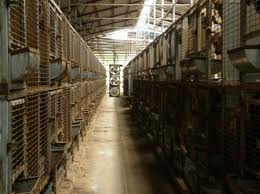
Dog farm

In China, the investigators discovered that cats and dogs were being raised on breeding farms, many small scale, but some were collected abandoned strays and some appeared to be stolen companion animals. Ironically, while long-haired cats are kept as pets in China, short-haired cats, especially ginger or grey tabbies were kept chained outside and raised for their fur.
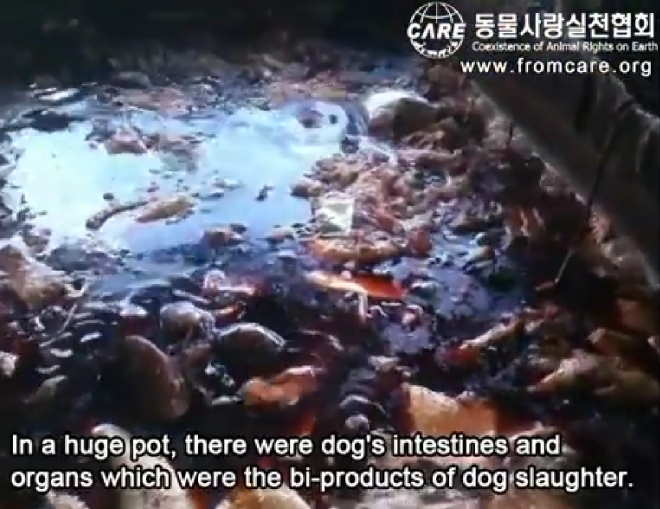
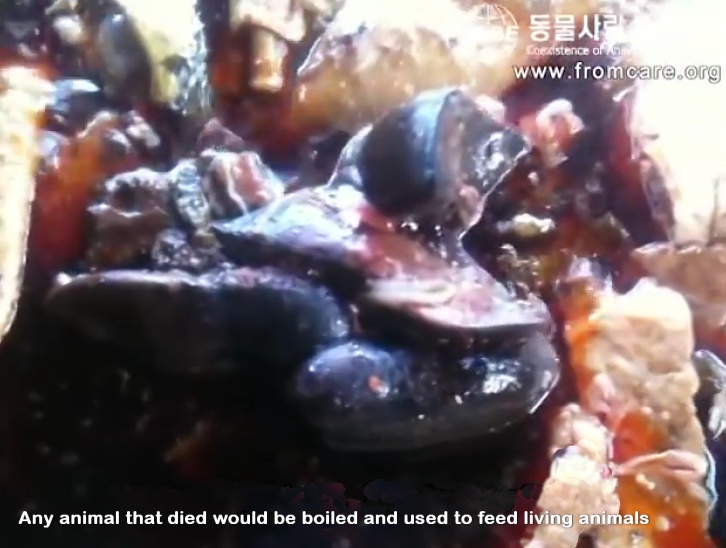
Dog meat trade new 2

Dog meat trade new 3

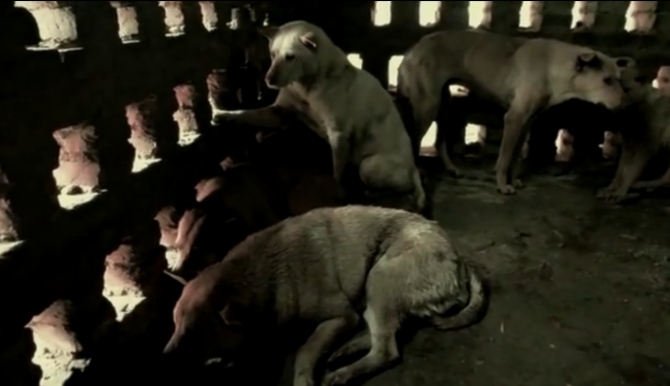
The larger breeding farms, which Karreman referred to as “worse than concentration camps”, kept up to 300 animals at a time in appalling, squalid conditions. They saw dogs, mostly pups under six months old, sitting in dark, windowless and bitterly cold sheds, surrounded by the bodies of dead dogs hanging from hooks. The dogs, chained by thin metal wire, were left with no food or water while they waited to be transported to slaughterhouses.
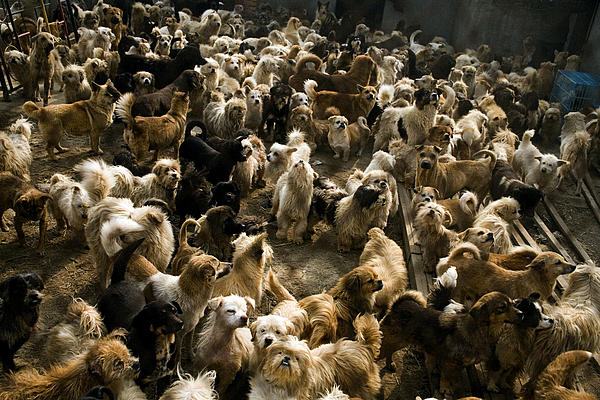
Dog and cat meat trade 14

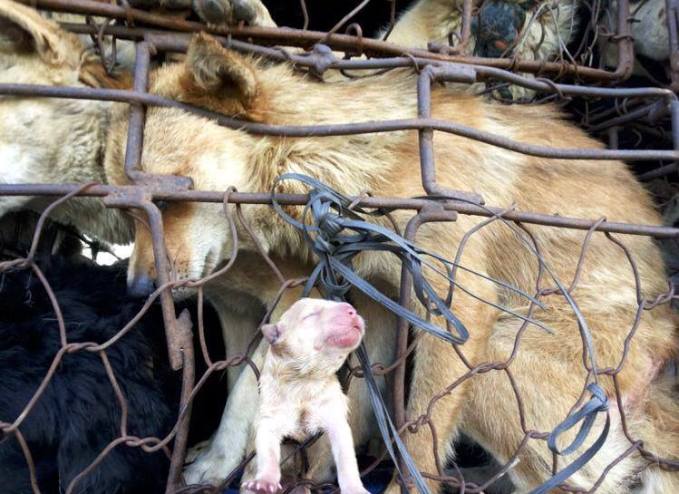
This was how the dogs lived out their short, grim existence before being crammed into tiny, filthy cages or sacks to make the harrowing journey to the slaughterhouse – a trip which can take days while they suffered without food or water and many are injured and die.
Dog meat trade 01

While being transported, dogs give birth and are powerless to stop the puppies falling out onto the road
Dog meat trade new 6

Dog and cat trade 6

Karreman and his team risked their lives getting inside the slaughterhouses. “These places were very difficult to find and access was even more difficult. We pretended to be suppliers and after we established trust with the dealers, we got to accompany them to the farms and the slaughterhouses. These dealers and butchers are ruthless gangsters, they would have killed us if we were discovered. I received many death threats afterwards and continue to get them. But for me it was worth it because otherwise these things will never stop. And some good did come out of it.
Dog meat trade new 4

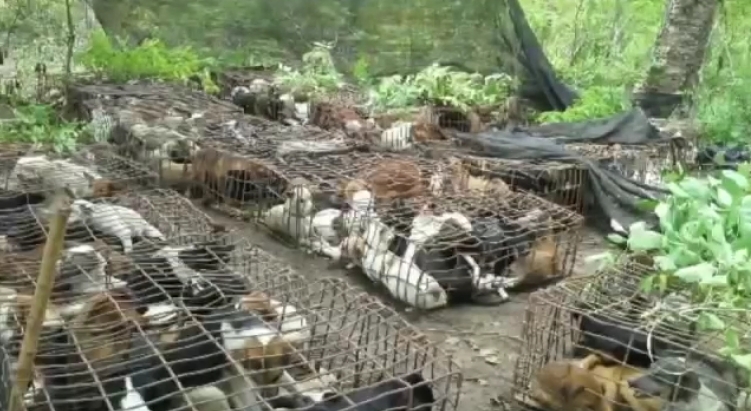
Increasingly, slaughterhouses are moved to remote jungle locations

“In the Philippines, the police raided some cat slaughter-houses after we gave them the addresses. They found thousands of cats who were about to be killed, about 30,000 stolen pets, which is one of the reasons the police raided it, because they were definitely stolen pets. And in Thailand they’re coming out with new animal protection laws because of the investigation.”
Dog meat trade new 8

However it is a different story in China, a country with one of the world’s worst animal abuse records. By the time the animals reach the slaughterhouse in the city of Harbin, many are sick and some are even dead. The investigators watched a truck arrive one evening, densely packed with dogs.
Dog and cat trade 4

“We had to watch these dogs being killed without showing any emotion”, Karreman says faintly in a strained, heartfelt voice. “It was a difficult, devastating experience, crying inside while speaking calmly. After a while your soul gets eroded. But it has to be done, otherwise you can’t deal with such people”.
Dog and cat trade meat and fur 14

Designers Dolce Gabbana, who have always been big on fur, came up with a microskirt made entirely of “Chinese cat”. When groups such as People for the Ethical Treatment of Animals (PETA) disclosed that this was, in fact, made from real domestic moggie, creating an uproar, D&G backtracked and claimed that it was actually ponyskin. “Well, if it’s not cat, why call it that?” says PETA’s Andrew Butler, adding, “Amazingly, they claimed that ponyskin was a euphemism for cat in Italian. When our Italian office asked for samples for DNA testing, they refused. And, of course, that one garment that was contentious has suddenly disappeared”.
Dog meat trade new 5

The fur renaissance, if you believe the hype, has started up again. “There is no fur renaissance”, says Gucci designer Stella McCartney, “It’s just the fashion industry’s sick, twisted little moment. Fur may be on the catwalk, but it’s not on the streets”. But perception is often stronger than the reality. The catwalks and fashion glossies are ablaze with animal prints and skins.

“These days nobody cool wears fur and there’s no excuse for wearing it”, says Andrew Butler: “Anyone who’s horrified that dogs and cats are kept in sickening, disgusting conditions, and that they suffer slow, brutal deaths, shouldn’t be buying fur because there’s no guarantee that the coat or the fur trim isn’t cat or dog. In fact, the likelihood is that it will be cat or dog because it’s cheaper to use”.

Dog and cat fur still being exported to the EU

SAFARUS Student Alliance for Animal Rights

Skinned Alive – Cats and Dogs Killed for the Fur Trade

Friend or Food? South Korea’s Cruel Dog Meat Trade

Gruesome Yulin Dog Festival Must End!
Dog and cat trade 8

Discussion Between Hunters And An Anti

Anti: This was almost certainly a set-up and this is just another piece of hunting porn a la Mark Sullivan.

Company: Thank you for taking the time to comment on this video. We would like to inform you that this was not a setup. This company has, and never will, create situations like this to promote videos. This happened on a normal hunt, where the group of hunters had the intention to kill the lioness as quickly as possible.  Hunters normally don’t have the desire to let their prey suffer, and I assure you the hunters in this group did not want to cause a charge deliberately. Thanks again for your input.

Anti: Unfortunately there are a lot of hunters that do enjoy to see their prey suffer. If you don’t believe me trying going over to the Facebook pages of some of the hunters and you will find out.

Company: I agree, and they are mostly responsible for the hate anti-hunters have. I can assure you this was not the case here. Many hunters like to leave a wounded animals for an hour or so, then it’s safer to follow up. The animal might have died, or at least stiffen up. With this lioness everybody decided to take the risk and go after her to stop the suffering quicker. Believe it or not, most hunters I know do care about the animal also.

Anti: Then the ethical hunters need to sort out the unethical ones who enjoy inflicting suffering and setting packs of dogs on caracals and bears, etc. and then boasting about it. This is despicable and in the end will destroy the hunting industry. Something needs to be done about it.

Hunter: You can’t put all hunters in the same category. I have the utmost respect for any animal I harvest and always ensure a quick and clean kill.

Commenter 1: If you had respect for the animal, you wouldn’t be killing it, you ignorant piece of shit.

Hunter: Respect does not mean you have to leave it alone. Animals cannot maintain themselves like hundreds of years ago because man has moved in on their territory, fenced them in or fenced them out. Now it’s up to SUSTAINABLE MANAGEMENT to ensure the species survive. Even if you don’t like it, doesn’t mean it’s not true.

You are so fucking dumb I don’t know where to begin. You know what your probably way to fucking stupid to even comprehend that hunting has been around since life on earth. I respect the meat the animal provides and that it is another form of life just as I am. Go to the grocery store before it closes you fucking pathetic piece of shit.

Anti: Leaving hunters to manage conservation is like leaving alcoholics to manage a wine cellar.

Hunter: You are a total fucking moron. Do you realize hunters manage almost all conservation? All the game laws were put in place by hunters. Go see how set up it is when you get ripped to fucking shreds by that lion. God damn you people are as ignorant as they get.

Company: It’s not the same. You cannot compare game (good thing) to alcohol (bad thing). It’s more like: Leave people that love wildlife in charge of managing wildlife. Hunters protect wildlife, similar to a sheep farmer protecting his sheep. Kill all and you have nothing left to continue working. Breed more and increase the population, and therefore your income also. Hunting outfitters increase game population.

Commenter:  These idiots always invent stupid ideas to defend themselves. Saying that hunters don’t like to see animal suffer is a vulgar joke after all they are killing an animal for no reason except for their ‘fun’.

Anti: You are so right. They are so full of bullshit.  They like to think they are brave but they are so cowardly they don’t even have the guts to use the proper word for the killing they do. They use the word ‘harvesting’ like the animal is a vegetable or some grain. How despicable!  How is that respecting an animal’s life or death?

Commenter 1: As ignorant as you can get.  It’s a lot more ignorant saying “God damn you” to someone who is speaking out for animals, against people who murder them for fun.

Commenter 2: I couldn’t agree more.  While plants are living beings too, we usually don’t feel their pain just because they don’t show us emotions like animals do. use of word harvesting is downright pathetic. By any chance are you associated with some organization that work for animal rights?

Anti: Yes I am an ARA (animal rights activist or advocate).

Hunter: Let me put it down in basics. I’d like to point out how retarded you sound. plain and simple, you’re an activist retard. Ur expecting the world is to work in a specific manner in which wildlife isn’t killed for sport, food, or in whatever other way you are assuming an animal may be killed for.  Well it is, and it will always be killed, whether for sport, fun, food, or defence. Whether you or thousands of other people want to believe it to be truth. there are people who live in the countries that these animals are hunted in and protect them in ways which don’t appeal to you but has kept these animals alive.

So if you are so eager to help these animals why are you on Youtube watching hunting films? Shouldn’t you be out there in the savannahs in a hut making sure poachers and hunters are shooting the animals? Or are you some kind of internet hippy just trying to comment stupid shit on things u have no clue about?

Company: Sorry for the late reply. I was away filming a leopard hunt. Before you criticize me, please read the complete post:

Five years ago there was NO wildlife in the area. NONE. Not even an impala. Everything was poached out by local miners and villagers alike.  An avid hunter and conservationist asked the government to step in and proclaim the area to be a hunting area. Strange, since there are no animals, you would say. But there I was, 5 years later, filming a leopard hunt. Because the area was not protected, it means that poachers can be shot on sight (Zimbabwean law).

Animals started to move back into the area. First only duiker and impala, then kudu followed. Later zebra joined in. While on the hunt, I put up trail cameras, and have photos of two different males and three females. One of these males was hunted. The first one in 5 years, and only one will be hunted. The income generated will pay for the area to be protected for another year. Next year there will be even more game, which will be protected because it can be afforded to have an anti-poaching team in the area.

There is no way that you can say this hunter does not care for wildlife. Yes, he killed one leopard, he also shot one zebra, but look at what he has accomplished!
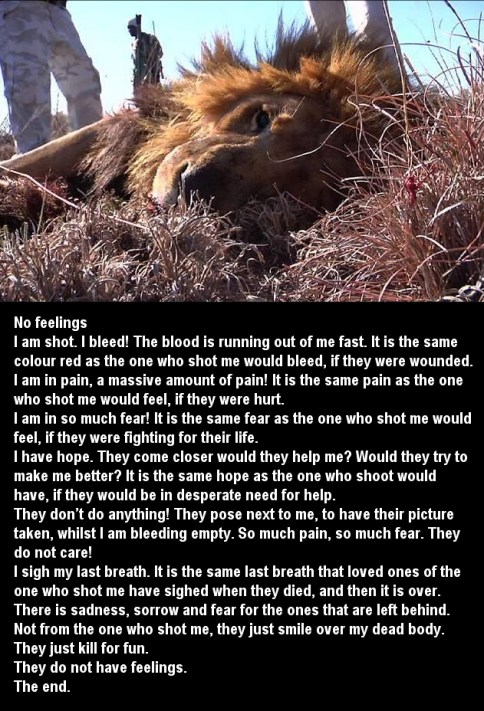
I saw cattle farmers and leopards getting along, where previously the cattle farmer will poison leopards. The farmers also gets a reward after the lion hunt, therefore he leaves the other leopard to live.

To sum up: I have respect for all ARAs on Facebook, Youtube etc, but there are people fighting the same fight you are, but in different ways. You need to be open to accept this fact. Not all hunters are poachers.

Thanks again for your input, I hope to hear from you soon.

Hunter: Wow You are as low as they come…Go eat a fucking leaf dumb fuck while I eat my steak.

Anti: People like you have a serious problem in that they can’t see how stupid they themselves are, and project that stupidity onto others. Read your statements and you will see they are the words of an uncivilized and uneducated imbecile. Still there is no shortage of those where you come from, where they have gone too far on the dumbing down.

Company: I haven’t seen a reply on my post about the leopard hunt. I’m not trying to pick a fight, I would honestly like to hear your opinion on the situation in Zimbabwe. Is this type of hunting a good thing, or still not acceptable to you as an ARA activist?

Anti: It’s wrong to kill any animal for anything other than need to survive for food and even that is disputable,  It is especially wrong to kill as a sport. How can normal people enjoy to end a creature’s life for a thrill?  The answer is they can’t, so it follows the people that do these things are NOT normal.

Hunter: Yea there are more people in the world that do it than don’t so you are the weird one. Many people live off the meat they take. Not everyone wants to be a skinny vegan.

Anti: Really so who eats cats?  Yes it’s true hunters try to make out that the antis are the weird ones.  However if you actually look at the surveys carried out you will see that every survey you look at says 85% to 95% of people are against trophy hunting in all its forms and actually trophy hunters are an extremely small minority of 3 to 5% at most.

Company: If killing one will save the species, it cannot be wrong, in my opinion. Thanks for your input, the world would be a dull place if everybody always agreed on everything.

Hunter: I never said I was for trophy hunting did I? I kill only what I eat. There is nothing wrong with having a few mounts on the wall as long as you ate the animal. I don’t know about lion but bobcat and mountain lion are some of the best eating you can get. I know some people go out and kill for the sake of killing but that is absolutely immoral. You may not think so but I highly respect the life of another animal. I never wish to see any suffering. I respect your opinion and choices but I have my own as well so I wish you do the same for me. No need to keep arguing.

Anti: Get an education. Did you know that thanks to people with your stupid ideas there are less lions left than jaguars?There are farmed lions who are sick due to weakened immune systems as they are taken away from their mothers shortly after birth, and many have TB and feline HIV.  Sick practices and all people involved in this are sick!

Hunter :I am done arguing with an idiot. Go die in a hole you worthless cunt.

Hunter: Wow I just read some of your other comments and you really are a psychopath. You belong in a mental institution.

Anti: Oh yes, sure. Well it would be very nice for you hunters if what you were saying was true. Hunters are the stupid mental cases who have a mass compulsion to spend small fortunes buying expensive camo so they can dress up to try to like a tree and make a treehouse so they can hide in one and then they call antis tree-huggers and treetards. What a joke.

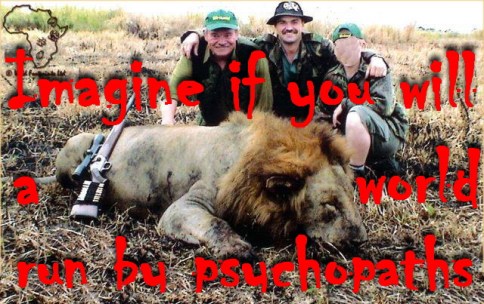
Your day is over, now you have to face the truth which is that people who enjoy killing animals are the ones who are in fact sick in the head. We already have all the evidence we need. 99% of serial killers abused and killed animals before they turned their attentions to humans. Sorry to be so blunt, but it’s hunters who are the psychos.

Thank you for this conversation which as it is typical of an exchange between hunters and antis it will be reproduced elsewhere – without names – as an example.

[Thanks to the hunting company for their courteous responses along with their helpfulness in allowing this conversation on their Youtube video comments.  In recognition of this, the name of their company has not been mentioned.]


Lion Farming and Canned Lion Hunting

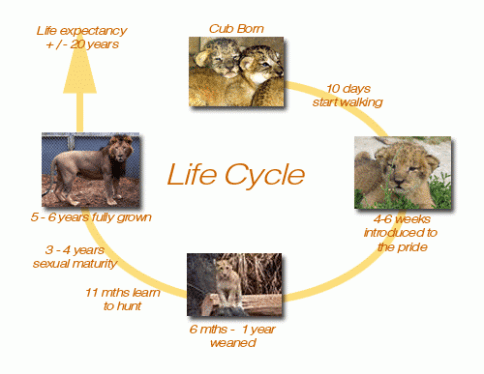
lifecycle

If people knew the truth about what happens in lion farming and canned lion hunting, most would want it stopped immediately.  I believe it is a case of getting the word out there, so everyone knows. If it can be made unacceptable to be seen or heard to be petting or walking with lion cubs due to its direct and close connection to trophy hunting – then the battle will be all but won.

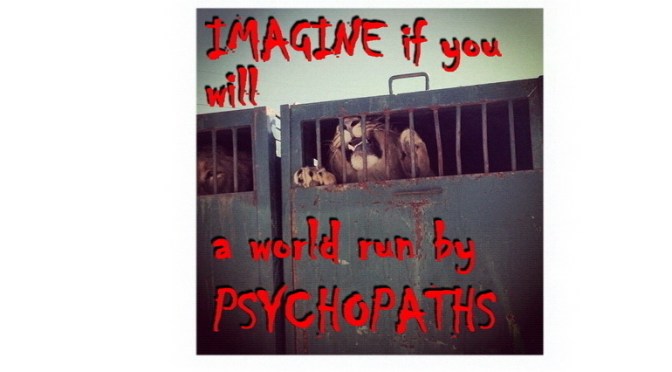
Lion farming is an un-policed industry and lion farmers are notorious for their deviousness, frequently telling half-truths and out and out lies. These are people who choose to make money out of a whole lifetime of misery for lions in captivity only to end their life early as fodder for psychopathic “trophy hunters”, people who choose to spend tens of thousands this way rather than help animals or people they choose to kill.

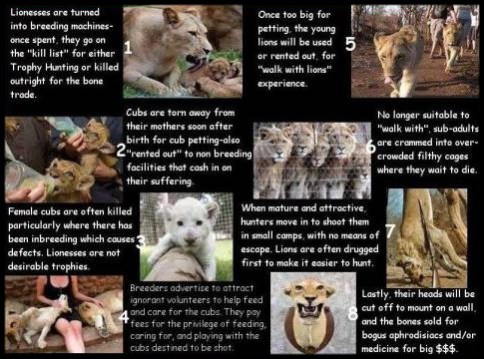
Lion farming – or canned hunting – starts with taking the cubs from their mothers a few hours after birth and keeping them separate in spite of their cries. As there is only a small window of time where cubs can be petted of about three months so there needs to be a constant supply of cubs and the lionesses are used as breeding machines. What happens to those lions once they are too old to breed, or the cubs when they are too old to be petted, and too old to be walked with at only one year old? Cubs are often declawed at least on the front paws which is an extremely painful process akin to amputation.

Canned hunting is a brutal practice where on the surface of it, outfits under various guises of safari parks, farms, lodges, reserves and retreats, appear to love and care for lions – often stated to be orphaned lions – are in fact lion farms. Tourists pay large sums of money to visit and extra to pet cubs and ‘walk with lions’ as if it were a Butlins or Pontins holiday camp. The reality behind the scenes is something far different. These places are more like concentration camps for the lions.

Also deceived are volunteers from all over the world who come from all the world and often pay thousands for the privilege of being able to help care for the so-called ‘orphaned’ lion cubs. These places are set up in such a way that even the volunteers who work there can be deceived as to what is really going on. The volunteers may stay there for week and not realize that the place where they have volunteered is far from what they thought, a place to help animals but rather it is a place where they are mercilessly tortured and used, locked up and forced to walk with tourists like a dog instead of roaming free.

Lion cubs are often used in various publicity campaigns, including being hired out for weddings or other events. For example, he ‘psychic’ ‘spiritualist medium’ John Edward claims to know about canned hunting, but nevertheless posted pictures of himself petting cubs and walking with young lions on his Facebook page. He says he did the research and the place he visited, Ukutula, are known to be involved in canned hunting and supply trophy hunters. The truth is that probably John Edward’s ‘research’ amounted to a single question during a telephone call.  [Let’s leave this unspoken but you know that I know but it’s OK.]

Ukutula and John Edwards Final USEUkutula Final Use THIS

No matter what they say, the vast majority of the outfits that provide cub petting and walks with lions DO provide lions for canned hunting. It is only extremely rarely that lions are genuinely orphaned. Or else what do they do with them? Lion cubs can no longer be petted with after only four months old, and no longer walked with after they are a year old.

The demand from zoos or circuses is now very much reduced due to the ever increasing legislation against animals being used in this way, but the demand for lion parts especially lion bones for so-called tiger bone wine along with people who want to eat lion meat, means that a dead lion is worth a lot of money.

It is not surprising the people who do these horrible things for profit tell lies about it. Just like the puppy mill breeders don’t want people to know or see the truth about the dogs they breed. On the face of it, it looks innocent. The terrible cruelty is carried on behind the scenes.

There are hundreds of game farms in South Africa alone with many thousands of lions who were taken from their mothers shortly after birth and hand-reared, destined for a short life to be ended in a horrible way when they are often drugged taken to fenced off enclosure – the reason it is called ‘canned’ hunting – to be killed by a trophy hunter. Anyone can go on the internet and buy a lion for this purpose from any number of establishments and suppliers.

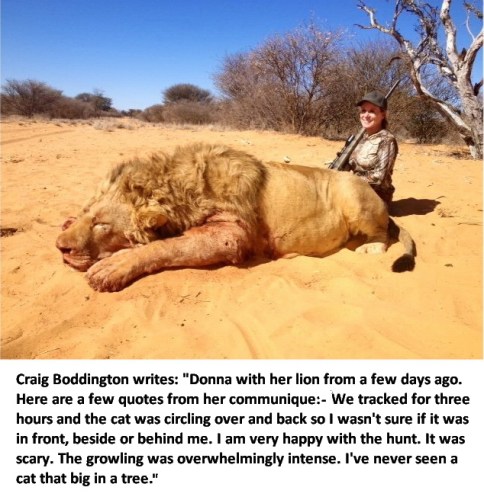
Lions - Trophy hunted by Donna Boddington

As many as half the lions killed in canned trophy hunting are killed by bow and arrow as the preferred weapon. It is more difficult to kill an animal with a bow and arrow and can be very distressing and painful. Many bowhunters are in fact sadists who enjoy the extra pain and distress that being killed this way usually causes. In order to preserve the head intact for the taxidermist often the animals are not shot in the head and whether shot by gun or by bow, often it takes several attempts to kill. In addition to this, many hunters are bad shots so it takes several attempts to kill the animal.

In the wild, lion cubs stay with their mother for two years where they learn how to hunt along with various social behaviours. In the natural state, lionesses have a litter about once every three years, but in lion farming, lionesses are forced to give birth over and over again, but are never allowed to keep the cubs.  They grieve and mourn terribly for cubs that are taken away from them. This is cruelty beyond belief.

The truth is that while humans enjoy petting and walking with cubs, it is not enjoyable for the cubs to be mauled by humans in that way and being made to walk like a dog. Having been taken away from their mother and hand-reared in a completely unnatural situation, the cubs simply don’t know any different.

Once reared in this way, the lions can never be released into the wild, as they have never learnt from their mother how to hunt and so they will always be magnetized to return to humans to supply their food. So the same people that hand-rear them in a false unnatural world, betray them to be sold to die an often painful death at the hands of an often amateur hunter. The lions cannot fail but understand that something is terribly wrong but there is no way for them to understand what that is.

There are pictures of lions at these farms showing that they are far too thin and clearly underfed and undernourished. Photographs also show that these animals look bored and unhappy and frustrated with their lives, as they are deprived of a natural life in the wild and all that would normally comprise. They are forced to do things that are unnatural, like walk with people as if they were dogs, and live in a unnatural way.

Often tourists are lied to, and unaware that the same lions they are petting and walking with will – at the end of their short and miserable life – be put in a field to be shot by someone who can’t think of anything better to do with thousands of pounds than kill for fun and bragging rights. Some will end up as part of a trophy room collection that can cost many millions as hunters fulfill hit-lists for various Safari Club International awards that involve travelling around the world to kill certain specific sub-species of animals.

Can you imagine the shock and horror for some people when they realize that the same cub they petted or walked with on their South African safari holiday had such a horrible life, with a future mapped out for them with an early death at the hands of despicable trophy hunters?

There are various indications that the true number of lions killed each year in Africa is far higher than we are led to believe and is possibly as high as 4,000 or even more. Many hunters from the US and elsewhere ‘dream’ of killing a male lion and see killing a lion – like some do an elephant – as a pinnacle of achievement.  The fact that most of the lions ‘hunted’ will in fact be canned lions, does not bother them. They lie about it to themselves and others.

Trophy hunters - Pinocchio

The sordid truth about canned hunting would offend the vast majority of people so the canned hunting operators take steps to deceive in order to pander to the pride and vanity of people that pay to kill animals, so they can boast about how they were the ‘great white hunter’.

They proudly tell their ‘hunting’ stories and show off their photographs taken next to the dead body, perhaps get a wallet or something made out of their skin, and/or take body parts, or the whole body back with them for stuffing and installing in their trophy or gun room.

Lion farming is not confined to Africa, and in the UK for example The Paradise Wildlife Park in Hertfordshire charges £250 per person to pet one of teir white lion cubs. As does the West Midland Safari & Leisure Park. As white lions are not an actual sub-species, those same white lions are known to suffer from various problems such as a high rates of both minor and serious birth defects due to in-breeding,

People and companies - Lions white West Midlands Safari Park People and companies - Lions white at Paradise Wildlife Park

Inbreeding of captive lions is causing serious problems so there is a much higher percentage of cubs being born with birth defects than would occur in the wild. These lions also suffer many nervous and other problems due to being frequently handled by tourists which is not natural for them.

The practice of hand-rearing captive lions comprises the health of the lions who are prone to suffer far more diseases and various health conditions than if they were raised by their mothers.  This makes them susceptible to illnesses such as tuberculosis which makes the threat of total extinction that much more of a realistic possibility.

These lions do not live a natural or pleasant life and this has been observed to have a profound effect on the lions, so that they are emotionally disturbed, as a human child would be. There are accounts of people who have worked in lion breeding outfits or farms who have been very distressed at what they have witnessed there, such as the account on the Sanwild Lion Rescue site.

canned-hunting-lions-life-cycle

South Africa has an appalling wildlife protection record in recent years fueled by corruption, lack of political will and pure out and out greed. Professor Pieter Potgieter, chairperson of the South African Predator Breeders’ Association, defended the industry saying there is little difference between breeding lions and any other mammal. “Chickens are killed by humans. How are lions different from them?” he asked.

“In principle a lion is not more or less than a crocodile, an ostrich or a butterfly. It’s a form of life. Breeding animals for human exploitation is a natural human process,” he said. Potgieter said that breeding and hunting lions was only deplorable in the eyes of the public because a “sympathetic myth has been created about the lion as the king of the animals”.

He justified the practice, saying the export of lion bones is a legal trade authorised by the department of environmental affairs and denied that South Africa’s approach to captive breeding and canned lion hunting was feeding into the Asian demand for lion bones. “I don’t think that market is being created by the South African situation. That would happen anyhow and the more the Asian tiger gets extinct, the more people will try to get hold of lion bones as a substitute,” he said.

The extinction risk for lions is now even greater than rhino.

The following is from an article by Faranaaz Parker in the South African newsapaper, Mail & Guardian:

“Conservationists have warned that captive breeding and canned hunting programmes in South Africa are providing a source for the lion bone trade. Canned lion hunting is legal in South Africa, as is the exporting of lion carcasses. Lion populations across Africa have been reduced by 90% over the past 50 years, but lion breeders say their operations have nothing to do with the continent’s wild populations.

Breeders can benefit financially a number of times from the same lion. Cubs are often rented as tourist attractions and visitors pay to pet and interact with them. The fee paid by visitors is then fed back into captive breeding programmes. As adults, the lions are sold to hunters in canned hunting arrangements.

Farmers and hunting operators charge in the region of about $20 000 (R160 000) as a “trophy price” and hunters can expect to pay around $18 000 (R145 000) for other services, excluding taxidermy.

But the hunters are only interested in the head and skin of the lion, and often leave the bones with the breeder, who can then sell the bones, with a government permit, to Asian buyers for use in making lion bone wine.

It’s estimated that a complete lion skeleton can sell for as much as R80 000. Last year it emerged that over 1400 lion and leopard trophies were legally exported from the country in 2009 and 2010.  [Most are exported illegally.]

The campaign against canned lion hunting

Lion killed

Please read this before you volunteer or pet or walk with lion cubs

Tigers Starved in Chinese and Vietnamese Farms

Big cats - Tiger farmsUntitled designBig cats - Tiger babyBig cats - Tiger cubs in jarsBig cats - Tiger medicines1526947_1472221649719665_5469101935424524167_nBig cats - Tiger medicines CITES ranger

A story in the Shanghai Daily underlines the huge disconnect between the conservation lie China spins around its tiger breeding operations and the grim commercial truth behind them.

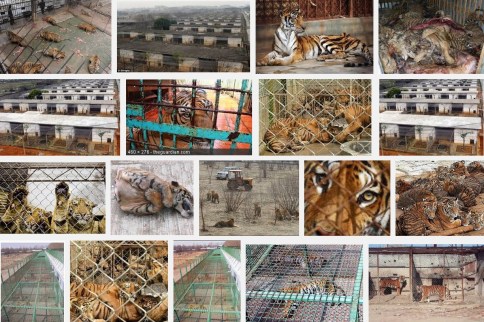
Fewer than 50 wild tigers remain in China, close to 10,000 are held captive on huge commercial tiger farms where they are bred and then killed to make tiger bone wine and other tonic products.  For every one wild tiger alive in the world today, there are three “farmed” tigers in China.  Farming tigers for trade creates market demand for dead tigers and motivates poachers throughout Asia to keep slaughtering these majestic creatures.

An estimated 800 to 1,000 tigers are born on tiger farms each year.  In these farms the tigers live lives of imprisonment in rows of squalid sheds, sometimes in perpetual darkness.  The cubs are separated from their mothers at three months old so the mothers can breed again to produce more tigers for the farms.  At around one year old they are killed and their bodies taken apart to be distributed for commercial gain.  The captive tigers are often kept in miserable and cramped conditions with very little, if any, monitoring to make sure the animals health and welfare is considered.

Behind rusted bars, skeletal tigers lie panting on filthy concrete cage floors, covered in sores and untreated wounds.   The bodies are so emaciated that they are little more than pitiful piles of fur and bones dying slowly from neglect and starvation.  Death actually can come as a welcome release.  [Source: Youth for Wildlife]

Big cats - Tigers started to make wine from their bones

Big cats - Tiger skins

ScreenShot007

Shanghai Daily News: Breeding center expects 100 more Siberian tigers

Harbin, 14 March 2014 – Xinhua: The world’s largest breeding center for Siberian tigers in northeast China’s Heilongjiang Province plans to increase its population by 100 Siberian tiger cubs this year, sources with the center said on Friday …

The country has been trying to save the species through active breeding programs. The Heilongjiang center has bred more than 1,000 Siberian tigers since its establishment in 1986, when it had just eight of the large cats.

EIA Wildlife Campaigner Shruti Suresh responds: “Tiger farms and smaller facilities in China hold more than 5,000 – 6,000 tigers and counting in captivity, along with an extensive ‘stockpile’ of tiger carcasses, skins and bones.

“The announcement made by one of China’s largest tiger farms is not only a flagrant violation of international law and policy, but is wholly unscientific and ludicrous.

“Under CITES, China is required to ensure that tigers are not bred on a commercial scale and that action is taken by tiger farms in China (such as through segregation of sexes) so that the existing massive captive tiger population in China does not grow any further.

“Further, it is obvious that the centre/tiger farm in questions does not understand the scientific meaning of conservation breeding.

“There is no doubt that these tigers are NOT bred for conservation purposes. Indeed, EIA investigations have found that captive tigers in China are bred and kept for commercial reasons – specifically for the lucrative trade in their skins and bones.”

It’s already too late for the Balinese tiger and this is the only picture in existence:

Big cats - Tiger, the only known photograph of a Balinese tiger

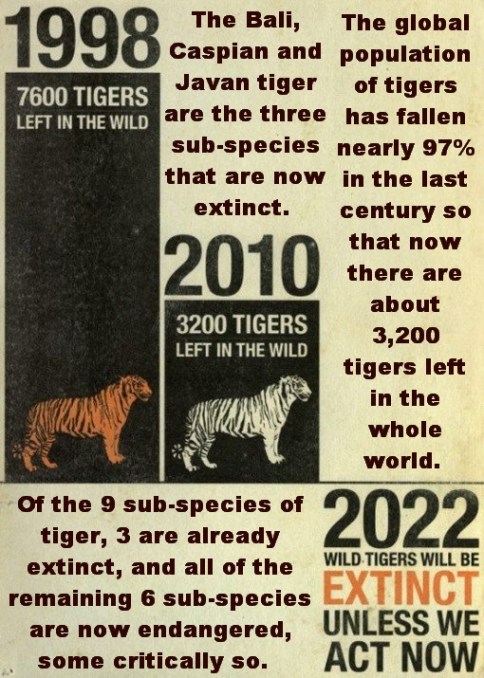
The global population of tigers has fallen nearly 97% in the last century so that now there are thought be only 2,500 tigers left in the whole world. Of the 9 sub-species of tiger, 3 are already extinct, and all of the remaining 6 sub-species are now endangered, some critically so.

Tigers are forced to compete for space with dense human populations, face unrelenting pressure from poachers, suffer retaliatory or trophy killings and experience habitat loss across their ranges.   All tigers, no matter where they live, seem to be under attack and threats against them continue to mount.

Message - World is large enough to share

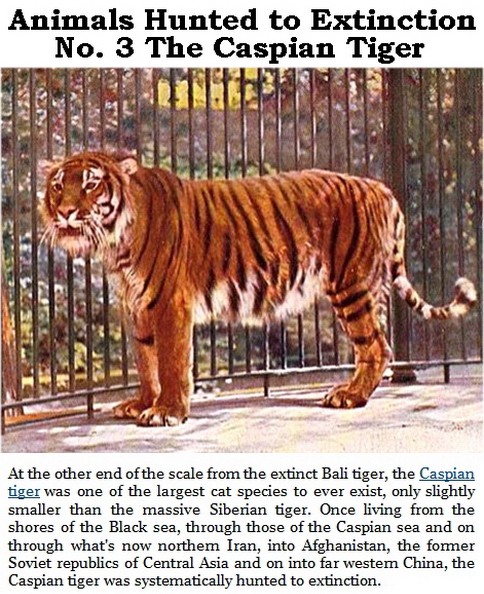
There were once 9 subspecies of tigers, but today there are only 6 remaining…the Royal Bengal, Indo-Chinese, Siberian (also called Amur), Malayan, South China and Sumatran.   The Bali, Caspian, and Javan tigers are now extinct.  The world’s forests are lost at a rate of 36 football fields per minute, according to the World Wildlife Federation.   This extensive habitat loss has forced wild tigers to live in small, isolated areas of their remaining habitat, making it harder for them to reproduce.  Increased road networks also leaves them more vulnerable to the wrath of poachers and overhunting of tiger prey species.  [Source: Youth for Wildlife]

Siberian tiger in severe decline with only 56 left in wild
http://news.bbc.co.uk/1/hi/sci/tech/8379095.stm

Hunters threaten Sumatran tiger with only 400 to 500 Sumatran tigers left in the wild
http://news.bbc.co.uk/1/hi/sci/tech/3514072.stm

Big cats - Tigers stats

Trophy hunters - Extinction animals hunted to No. 3 Caspian Tiger

Click here for a detailed and informative article
http://www.youthforwildlife.com/tigers.html

Cat Watch on illegal tiger trade and why tigers are walking gold
http://newswatch.nationalgeographic.com/2014/04/03/baby-baboons-dramatic-encounter-with-lions-ends-with-a-heroic-twist/?

Article in The Guardian about tiger bone wine
http://www.theguardian.com/environment/blog/2011/dec/06/china-tiger-bone-wine-auction

Big cats - Tigers are not for sale

Big cats - Tigers help save me

Big cats - Tiger cub we will never stop fighting

Please help by signing and sharing these petitions:

Tigers Reduced to Skin and Bones
https://secure.avaaz.org/en/petition/NPC_Standing_Committee_The_Peoples_Republic_of_China_End_Tiger_Farming_Now/?pv=21

Shut down China’s tiger farms
http://forcechange.com/92385/shut-down-chinas-tiger-farms/

Close all tiger farms in China
https://secure.avaaz.org/en/petition/Close_all_Tiger_farms_in_China/?pv=11

Tiger Time
http://tigertime.info/supporters

Dark secret of the farm where tigers bodies are plundered
http://www.dailymail.co.uk/news/article-1252500/Exposed-Dark-secret-farm-tigers-bodies-plundered-make-185-wine.html

Tigers in farms at risk due to malnutrition could be wiped out by a simple virus like distemper
http://www.bbc.co.uk/news/science-environment-22812914

What is wrong with tiger farms
http://cat-chitchat.pictures-of-cats.org/2009/03/tiger-farms.html

China stop selling tiger wine
http://www.thepetitionsite.com/330/667/187/china-stop-selling-tiger-bone-wine/#

People places companies - China 20 failures

Volunteering at SA Game Reserves

This list has been compiled by “Volunteers in Africa Beware”

Please visit their Facebook page for further information as they have extensive knowledge and will answer individual queries.

https://www.facebook.com/volunteersbeware

THE GOOD, BAD AND UGLY LISTS FOR VOLUNTEERING PLACES IN AFRICA

The updated list as of 09/11/2014 of GOOD places that we recommend so far to potential volunteers includes:

• Shamwari Game Reserve – Host to Born Free Big Cat Sanctuary – www.shamwariconservationexperi ence.com (SA)

• LionsRock – www.lionsrock.org (SA)

• Drakenstein Lion Park – www.lionrescue.org.za (SA)

• Wild cats World – www.wildcatsworld.org (SA)

• Cat Conservation Trust – www.predatours.co.za (SA)

• Wildlife ACT – www.wildlifeact.com (SA)

• Bahati Volunteer Programme – https://www.facebook.com/ pages/ Bahati-Volunteer-Programme/ 610413172406914?ref=ts&fref=ts (SA)

• Jane Goodall Institute’s Chimp Eden – www.janegoodall.co.za(www.chimpeden.com (SA)

• Vervet Monkey Foundation – www.vervet.za.org (SA)

• Kariega Game Reserve – www.kariega.co.za (SA)

• FreeMe Wildlife Rehabilitation Centre, Gauteng – www.freemewildlife.org.za (SA)

• Kwa Cheetah Breeding Project – www.cheetahinteraction.com (SA)

• Jukani Wildlife Sanctuary – www.jukani.co.za (SA)

• Monkeyland & Birds of Eden – www.monkeyland.co.za
www.birdsofeden.co.za (SA)

• Siyafunda Wildlife and Conservation – www.siyafundaconservation.com (SA)

• Samara Wildlife Volunteer Programme – www.volunteersamara.wordpress.com (SA)

• Askari Wilderness Conservation – www.askariwcp.com (SA)

• Amakhala Game Reserve – www.amakhala.co.za (SA)

• Kaapsehoop Horse Trails – www.horsebacktrails.co.za (SA)

• Umkwali – www.umkwali.com (SA)

• Global White Lion Trust – www.whitelions.org (SA)

• Kevin Richardson Lion Sanctuary – www.lionwhisperer.co.za (SA)

• Campfire Academy – www.campfire-safaris.com (SA)

• Khamai Reptile Centre – www.khamai.co.za (SA)

• Protrack Anti-Poaching Unit – www.protrackapu.co.za (SA)

• Umkhondo Big5 Wildlife – www.bigfivevolunteer.com (SA)

• Modgaji Conservation and Rehabilitation Projects – www.modgaji.co.za (SA)

• Daktari Bush School – www.daktaribushschool.org (SA)

• C.A.R.E. Centre for Animal Rehabilitation and Education –www.primatecare.org.za (SA)

• Ingwe Leopard Research, Mpumalanga – www.ingweleopard.com (SA)

• Tuli Wilderness – www.tuliwilderness.com (Botswana)

• Legodimo Wilderness – www.legodimo.com (Botswana)

• IDA Africa, In Defense of Animals – www.ida-africa.org (Cameroon)

• Limbe Wildlife Centre – www.limbewildlife.org (Cameroon)

• Ape Action – www.apeactionafrica.org (Cameroon)

• Projet Primates – www.projetprimates.com (Guinea)

• Mara Naboisho Conservancy – www.maranaboisho.com (Kenya)

• Tsavo Cheetah Project – www.tsavocheetahproject.org (Kenya)

• Colobus Conservation – www.colobusconservation.org (Kenya)

• Lilongwe Wildlife Centre – www.lilongwewildlife.org (Malawi)

• EHRA – Elephant Human Relations Aid – www.desertelephant.org (Namibia)

• N/a’an ku sê Foundation – www.naankuse.com (Namibia)

• CERCOPAN – www.cercopan.org (Nigeria)

• Ann Van Dyke Cheetah Centre (De Wildt Shingwedzi Cheetah Ranch) – www.dewildt.co.za (?) Some interaction with ambassador cheetahs allowed, removing some cubs to be hand-reared and very few released cheetahs. Most are sold to zoos (SA)

• Dell Cheetah Centre – www.dccafrica.co.za (?) Some interaction with ambassador cheetahs allowed (SA)

• Daniell Cheetah Project – www.daniellcheetahproject.com (?) Some interaction with ambassador cheetahs allowed (SA)

• C.R.O.W. Centre for Rehabilitation of Wildlife – www.crowkzn.co.za (?) (SA)

• International Primate Rescue – www.iprescue.org (?) (SA)

• Moholoholo Wildlife Rehabilitation Centre – www.moholoholo.co.za (?) Some interaction with animals allowed (SA)

(?) – These projects are overall good but may have certain practices that some people/conservationists may disagree with. More feedback about these projects is appreciated. We are trying to identify and promote good conservation projects and wildlife sanctuaries that are not connected to canned hunting or promoting hunting as a conservation method.

These are places that, in OUR opinion, are not involved in immoral practices like forced breeding and selling animals to hunting reserves, that try their best to care for wildlife and from whom you’ll have a lot to learn from spending time there. We do not know anything about the accommodations they offer, the food, transportation etc.

WE ALWAYS RECOMMEND YOU DO YOUR OWN RESEARCH TO DECIDE IF A PROJECT IS RIGHT FOR YOU. If you book through a travel agency, you can give them a list of places that you like and you can mention that you don’t want to volunteer at a breeding farm, they will know what you mean.

PLEASE LET US KNOW, PUBLIC OR PRIVATE, WHAT DO YOU THINK ABOUT THIS LIST,

WE CAN’T DO THIS WITHOUT YOUR HELP. Any reason any of these places should not be on the good list? Any place you know about that should be added?

REMEMBER, WE CANNOT INCLUDE ON THE GOOD LIST ANY PLACE INVOLVED IN FORCED BREEDING, PETTING FOR PROFIT, AND MOST OF ALL SUSPECTED OF INVOLVEMENT WITH THE CANNED LION INDUSTRY.

THANK YOU.

______________________________

The updated list of BAD and UGLY places to avoid if you volunteer in Africa, according to our research:

= THE UGLY =

AS A GENERAL RULE, PLEASE AVOID ALL THE BREEDING FARMS WITH A LOT OF CUBS AND A LOT OF OLDER MALE LIONS AS THESE ARE SIGNS OF CONNECTION TO CANNED/TROPHY HUNTING.

• LETSATSI La Africa – www.letsatsi-la-africa.co.za – EVIL place!!! (SA)

• LIMPOPO PREDATOR PARK – www.predatorpark.co.za ANDwww.ingogosafaris.co.za – Owned by the same person Walter Slippers!!! (SA)

• BOSKOPPIE Lion and Tiger Reserve – www.boskoppie.com (SA)

• MORESON Ranch – www.moresonranch.co.za (SA)

• UKUTULA Lion Park & Lodge – www.ukutula.com (SA)

• AFRICAN DANKBAAR Lion Breeders – www.facebook.com/…/African-Dankbaar-Lion-Bree…/ 106729123983… (SA)

• HORSEBACK AFRICA – www.horsebackafrica.com/ |www.colin.co.za/lion_tours.htm | www.walking-with-lions.za.net/ (SA)

• MABULANI GAME RESERVE – www.mabulani.co.za/ Xara%20Mabulani/activities.htm (SA)

• SEAVIEW Predator Park – www.seaviewpredatorpark.com (SA)

• LION PARK – www.lion-park.com (SA)

• Mbidi Resort and Animal Sanctuary (RAMELA RANCH) –www.tigerman.co.za (www.ramelaranch.co.za – Breeding, hand-raising cubs and using them to attract volunteers, allowing petting, using tigers, lions or cheetahs (cubs and adults) for walks, swiming or shows….using animals only for profit, but NO known connection to hunting (SA)

• Bagamoya Wildlife Estate – www.bagamoyawildlifeestate.co.za – Breeding, taking young cubs away to hand-raise them, allowing petting and sometimes selling lions (SA)

• Otavi Lion Park – www.otavilionpark.co.za (SA)

• Caring4Catz Voluntarily Project – www.facebook.com/ Caring4Catz?ref=stream (SA)

• Zebula – www.zebula.co.za – Breeding and petting of lion and tiger cubs, elephant rides (SA)

• Tshukudu Game Lodge – www.tshukudulodge.co.za/ – Volunteer-program-launches – connected to the beginnings of canned hunting by the Cook Report, lion farm with a separate hunting business on the reserve www.sussens.co.za/about-us.php (SA)

• Ingwe Wildlife Centre – www.ingwewildlife.co.za – Breeding and taking cubs away to hand-raise them, using cubs to attract volunteers, allowing petting, ties to Letsatsi and Limpopo Predator Park and the owners are game traders who sell wildlife including lions (SA)

• Sondela Nature Reserve – www.sondela.com – Using cubs to attract volunteers, offering petting, have been raising cubs for Limpopo Predator Park (SA)

= THE BAD =

We don’t believe these places are directly connected to canned hunting but they are doing practises that we don’t agree with, such as breeding and using the cubs to attract volunteers, animal interaction for entertainment or profit, elephant rides, etc.  More feedback from these sites appreciated. Please send a message or post to our Facebook page. Thank you.

• Kwantu Game Reserve – www.kwantu.co.za – Forced breeding lions with the purpose of attracting volunteers, but taking good care of the animals, also selling lions, possibly to hunting reserves, but NOT related to Canned hunting (SA)

• Marakele Predator Centre – www.marakelepredatorcentre.co. za – Breeding, allowing petting and occasionally selling lions (SA)

• Buffelsdrift Game Lodge – www.buffelsdrift.com – Offering elephant rides (SA)

• Knysna Elephant Park – www.knysnaelephantpark.co.za – NSPCA reports cruel and abusive training methods employed to control and train baby and young elephants to use in the elephant-based tourist industry, offering elephant rides (SA)

• Tenikwa Wildlife Awareness Centre – www.tenikwa.com – Serious concerns regarding the welfare of the primates in their care, also safety related concerns (SA)

• Lory Park Animal and Owl Sanctuary – www.lorypark.co.za (SA)

• Mukuni Big Five Safaris – www.mukunibig5.co.zm (Zambia)

• ALERT (African Lion & Environmental Research Trust) –www.lionalert.org/page/ about-us – Part of a force breeding and lion exploitation business through petting and walks with lions, not connected to canned hunting (Zambia)

• LION ENCOUNTER – www.lionencounter.com – Breeding farm exploiting lions through petting and walks with lions, not connected to canned hunting (Zambia/Zimbabwe)

• ANTELOPE PARK – www.antelopepark.co.zw – Force breeding lions, exploiting lions through petting and walks with lions, not connected to canned hunting (Zimbabwe)

The lists are based on opinions expressed by former volunteers and conservationists on Facebook, blogs, reviews and also in articles published on this subject. We do not have any connection to any of the places listed and the reason for our work is to help the volunteers avoid projects involved in immoral practices such as force breeding, petting or canned hunting. We are not engaging in undercover operations.

Please let us know if there is a good reason why any of these places should not be on these lists.

This list is a work in progress.

Reporting Animal Abuse to The FBI and Interpol

If you witness abuse to children or animals in videos or pictures on Facebook or other internet sites, please do not report to site managers as they will not usually take any action to stop the abuse, nor assist police in inquiries, and valuable evidence would be lost.

Ctrl F will search this article

General advice
http://www.fraudaid.com/solution_center/jurisdictions/overseas%20and%20intl.htm

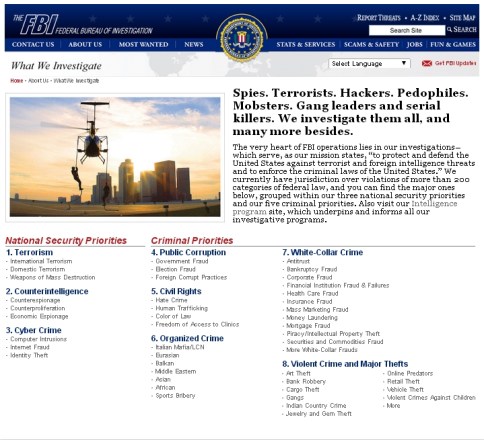
The FBI Is classifying animal abuse as a top-tier felony
[2 Oct 2014] Earlier this week The Federal Bureau of Investigation announced that animal abuse will be prosecuted as a “crime against society,” making it a Group A felony equal to arson and murder in the eyes of the law.

The FBI will reportedly begin collecting information about animal abuse in January of 2016, taking the time to restructure internal systems and systems of reporting crimes.

http://elitedaily.com/news/world/fbi-classify-animal-abuse-top-felony/782161/

Abuse an animal, and you’ll be considered among the ranks of murderers and cannibals.

The AP reports that The FBI will prosecute intentional abuse and torture, gross neglect, sexual abuse and organized abuse, which includes dog fights.

The policy change is an effort to prosecute more animal abusers, landing them in jail and setting an example. Animal abuse is not simply a minor crime.

How to report apparent animal abuse online
If you know where the abuser lives, report the incident/s to their local police station as local police often do investigate and take action against online crime.  Often that person will be involved in other crimes affecting his neighborhood.

If you do not know the location, instructions how to find an ISP are further on in this article under DNSstuff.

Report crimes to Interpol for crime committed outside of the US or The FBI for crime within the US.  Within the UK report to the Police and to the RSPCA.

Instructions for reporting animal cruelty and pedophiles on Facebook
1. Do not report to Facebook.
2. Send the URL for the picture or video you want to report.
3. Put your email address in the appropriate box, put “GRAPHIC VIOLENCE ON FACEBOOK [or other site]” in the subject box, and then paste the “URL” for the photo or video you wish to report – with a brief message to Interpol (see below for sample).  If possible, include some screenshots, which could be used as evidence.

Sample Statement
I have been witness to blatant animal cruelty (or child abuse) on Facebook at this link:
_____________________________

These images are extremely disturbing and clearly establish blatant crimes against animals (or children).

After viewing the provided material, you will understand that this is indicative of unlawful acts of animal cruelty (or child abuse) as established by the (Animal Welfare Act) and relevant local and international statutes.

I respectfully request that your resources be applied to remove this material and charge the perpetrators with relevant unlawful crimes.

Thank you for your rapid attention to this urgent appeal.

Signed_______________________________

Reporting Internet Animal Abuse [HSUS Information]
The Internet can be a powerful medium for connecting us to information to combat animal cruelty, but it also can be a haven for animal abusers who celebrate and actively advertise their shocking crimes. The best way to stop this type of abuse is to immediately report it to the proper authorities and to refrain from contacting, visiting or forwarding links to the offending sites.

Why is it important to report suspected Internet animal cruelty?
Reporting any type of suspected animal cruelty may save animals’ lives as well as people’s lives. When animals are abused, people are also at risk. The link between animal abuse and other forms of societal violence is well-documented. It is critical to immediately report conduct on the Internet that you suspect may be — or that you know is — animal abuse.

If I see animal cruelty on the Internet, what should I do?
Immediately contact the Internet Crime Complaint Center (IC3), a partnership between The FBI and the National White Collar Crime Center, at http://www.ic3.gov/

The website will direct you to the page where you can file your complaint. At first glance, it may appear that the website will only consider complaints of Internet monetary fraud. However, IC3 is the proper venue for all Internet crimes, including animal abuse.

IC3 can best process your complaint if the information you provide is as detailed and complete as possible. This includes providing the complete URL [website address] for the website that displayed the suspected animal cruelty.

Even if you are located outside the United States, IC3 will review your report as long as the suspected abuser is located in the United States.

What happens after I file a report with the IC3?

IC3 will email your report ID and password to you, along with a link to an area on the IC3 website where you can view your report and enter any additional information.

Upon receipt of your report, IC3 will carefully evaluate it and refer it to the appropriate federal, state, local or international law enforcement or regulatory agencies. Every report that is referred is sent to one or more law enforcement or regulatory agencies that have jurisdiction over the matter. At that point, the report may be assigned to an investigator. IC3 cannot guarantee that your complaint will be investigated.

What else can I do?
As abusive content often violates the user agreement that the creator of the website has signed with the Internet Service Provider (ISP), notifying the ISP about the abusive content may result in the website being removed from the Internet.

To make a report to the ISP, you need to determine who hosts the website. Go to http://www.domaintools.com/ and enter the website URL in the “Whois Lookup” search box and click search. Scroll down the results page until you find the numerical Internet Protocol (IP) address assigned to the website.

Go to American Registry for Internet Numbers http://www.arin.net/ and enter that IP address in the “Search WHOIS” box and click search.

The search results page will provide information on the ISP that hosts the website. The page also might display information about how to report abuse. If it does not, go to http://www.search.org/ and find the complete contact information for the ISP on the list. All of this information should also be included in your FBI complaint form, where possible.

If you believe an animal is in immediate harm, and if the location is known, contact local police and your local FBI branch office as soon as possible. To find your local FBI branch, visit http://www.fbi.gov/contact/fo/fo.htm

How does the law currently handle Internet animal cruelty?
Because communications through the Internet have the ability to cross state lines, the Internet is largely governed by federal law. Improving the federal laws as they pertain to Internet animal abuse is critical. Currently, only a few federal laws address the issue directly:

The Crush Act (P.L.106-152) penalizes the display of acts of cruelty and sexual abuse of animals that is intended for interstate commerce. If convicted, offenders may receive up to five years in prison or a large fine. Two criteria must be met before this statute applies: (1) actual abuse must occur and (2) the website in question must intend to sell the images across state lines.

In other words, a website may legally display images of animal cruelty and sexual abuse under this law as long as it is not charging visitors for access or otherwise selling the images. In 2005, the first conviction under this statute occurred in a federal district court in Virginia.

The Animal Fighting Prohibition Enforcement Act (P.L. 110-27) strengthens the ability of law enforcement to combat animal fighting by providing felony penalties for interstate commerce, import and export related to animal fighting activities, including commerce in cockfighting weapons. Each violation of this federal law is punishable by up to three years in prison and up to a $250,000 fine for perpetrators.

Internet Hunting: The Computer-Assisted Remote Hunting Act (H.R. 2711/S. 2422) is a pending federal bill introduced by Rep. Brad Sherman (D-CA) and Sen. Sheldon Whitehouse (D-RI). It seeks to prohibit knowingly making available a “computer-assisted remote hunt” (using a computer or other device, equipment or software to control the aiming and discharge of a weapon to hunt).

Filing a Complaint with the IC3

The IC3 accepts online Internet crime complaints from either the actual victim or from a third party to the complainant. We can best process your complaint if we receive accurate and complete information from you. Therefore, we request that you provide the following information when filing a complaint:

  • Your name
  • Your mailing address
  • Your telephone number
  • The name, address, telephone number, and Web address, if available, of the individual or organization you believe defrauded you.
  • Specific details on how, why, and when you believe you were defrauded.
  • Any other relevant information you believe is necessary to support your complaint.

http://www.ic3.gov/default.aspx

Reporting animal cruelty outside the USA

If the crime is not within the US, it should be reported to INTERPOL. You must include as much information as you can including links to the offending material, names, locations, etc. [More information on Interpol further on in this article.]

The submission page for crime tips for INTERPOL
http://www.interpol.int/Forms/Contact_INTERPOL

Reporting animal cruelty within the USA
The FBI investigates all forms of cybercrime and reports can be submitted at FBI Cybercrime Investigations Report
http://www.fbi.gov/about-us/investigate/cyber

You would follow these instructions to report a US based crime, even if you are not a resident of the US or are not located within the US at the time of the discovery.

To report an animal cruelty or abuse crime that takes place within the United States, report the incident to The FBI. You must include as much information as you can including links to the offending material, names, locations, etc.

The submission page for crime tips for The FBI is https://tips.fbi.gov/

A US based animal cruelty website ought to be reported to the Internet Crime Complaint Center, also known as IC3.

The Internet Crime Complaint Center (IC3) is a partnership between the Federal Bureau of Investigation (FBI) and the National White Collar Crime Center (NW3C) http://www.ic3.gov/default.aspx

At the time of writing, there is no category for animal abuse, so choose a category and explain the situation in the notes. As much information as possible should be included in the report including links to the offending website.

Other resources for reporting Internet animal abuse, especially if you believe an animal to be in danger at the current time IE live streaming video, and you know the location of the offending party, include reporting to the local police and the possible offender’s local FBI branch as listed here http://www.fbi.gov/contact-us/field

FBI 1

FBI 2

Animal Legal Defence Fund
http://aldf.org/resources/when-you-witness-animal-cruelty/

PETA People for the Ethical Treatment of Animals
To report an animal in imminent danger
http://www.peta.org/about/contact-peta/report-cruelty.aspx
http://www.peta.org/about/contact-peta/email-form.aspx

http://www.peta.org/action/get-active-online/cruelty-internet/#ixzz32rhmJnVw

Check for any specific laws protecting certain species here
http://www.fws.gov/

Wildlife Crime
Traffic – the wildlife trade monitoring network
http://www.traffic.org/home/2014/8/7/landmark-for-wildlife-crime-database-eu-twix.html
Email – traffic@traffic.org
https://www.facebook.com/trafficnetwork?fref=photo

WildLeaks secure whistleblower site for wildlife and forest crime
https://wildleaks.org/

*Kruger National Park Emergency Hotline 013 735 4325 / 013 735 0197 or 076 801 9679.
* Counter poaching hotline: 0800 205 005
* Crime line: SMS 32211 or call 08600 10111
* Customer Care: Email – customercare@sanparks.org or call 012 426 5017

It has come to our attention that there are Websites and Social Media Platforms that are not SANParks official sites that are advocating that incidents in Kruger National Park be reported to them and not to SANParks directly. We therefore request that SANParks be considered as the main contact for reporting incidents. SANParks has other official Social Media platforms apart from Facebook that can be used to report sightings and Incidents as follows:

Twitter Handle – SANParksKNP
Instagram Username – SANParksKNP
(Lesley Nyawoill)

Cleaning Up the Internet
With sites like Myspace and Youtube, please immediately bring any offensive videos to PETA’s attention by emailing us at Info@peta.org.

We require a direct link to the video and to the poster’s web page. Do not post angry comments, and do not complain to the social-networking or video-sharing site about the video, as it might remove the video before PETA has the opportunity to investigate.

As a precaution, please download the video and save the web page/user profile so that PETA can be sure to view both. After our investigation, we will petition the site to remove the video and delete the user’s account.

In cases involving commercial gore and pornography based websites carrying videos of animal abuse for shock purposes, your response will be different. Find the contact address for the website, and identify the website’s internet service provider (ISP). DNSstuff can help you do both.

DNSstuff
Using this site to find contact information for a website is easy. Use the “WHOIS Lookup” option (on the left side of the DNSstuff home page) to perform a search using the domain name. The domain name for PETA’s website, for example, is “PETA.org.” Again, don’t complain directly to the offending site, as this could encourage the site owner. Instead, report it to the appropriate FBI office at http://www.fbi.gov/contact/fo/fo.htm

DNSstuff also makes it easy to find information about the offending website’s Internet service provider (ISP).  First, use the “ping” tool on DNSstuff’s home page to find the IP (Internet Protocol) address for the website; all you have to do is enter the domain name!

Then, enter the IP address into DNSstuff’s “IPWHOIS Lookup” search field, and you’ll get the ISP information! In addition to contacting the ISP representatives directly and explaining to them why the site and/or the offensive files should be removed, ISP information should also be included in your FBI complaint.

Notes
The internet is rife with websites and webpages depicting cruelty to animals. Some sources are educational, depicting the cruel behind-the-scenes reality of industries that thrive on animal exploitation and abuse. Other sources are merely depicting cruelty for shock value. Often, these sites will also carry videos and images that are gory and/or pornographic in nature.

These websites are counting on you to be upset by what you see, inadvertently bringing them more traffic – and consequently more advertising dollars – with your complaints to friends, family, and coworkers. The site owners thrive on your angry messages, often posting them for their sympathetic audiences to enjoy.

Social-networking sites like Myspace and media-sharing sites like Youtube allow users to create their own webpages (in the case of Myspace) and to post blogs, photos, videos, and music. Some people abuse this service by posting videos depicting crimes against animals. Many abusers have been brought to justice after flaunting these crimes online. With your help, abusers can continue to be put behind bars.

Important notes on how and where to report animal cruelty
The Internet delivers an astounding array of images and ideas into homes across the world – but not all of these images are particularly animal-friendly. In the United States, individuals have the constitutional right to free speech, which includes the right to discuss and advocate for animal abuse in public forums like the Internet.

Unfortunately, some of what is being shown online crosses into the realm of illegal activity. Rest assured, animal cruelty is a crime in every state—if people go beyond discussion and actually practice what they preach, they can be prosecuted for animal cruelty under their local laws.

What is a hoax?
While some online images of animal cruelty are, sadly, all too real, many websites that appear, at first glance, to promote animal cruelty are hoaxes. Of course, websites that are disturbing or disgusting are not breaking the law if no animals are actually being harmed. While you can certainly express your opposition to these sites to the companies that host them, be aware that their content can be protected by the First Amendment.

Remember, hoaxes and parodies on the Internet, no matter how offensive, are exempt from cruelty laws.

Where to report
Find out who is responsible for investigating and enforcing the anti-cruelty codes in your town, county and/or state. These people typically work for your local humane organization, animal control agency, taxpayer-funded animal shelter or police precinct.

If you run into trouble finding the correct agency to contact, you should call or visit your local police department and ask for their help in enforcing the law. If your local police department is unable to assist, ask your local shelter or animal control agency for advice.

Reporting online cruelty
This applies to any abuse seen on the internet worldwide, on any site.  Do not protest to Facebook, Youtube, Google, blogging platforms such as WordPress or any other website to “shut down or remove” animal abuse sites, videos or pictures. As none of these sites report animal abuse to law enforcement agencies. The reason for this is that they may shut down the pages or sites, leaving no avenue for the people to be located and arrested and prosecuted, or for the animals to be located and saved.

The main things you must NOT do:

Do not contact the website owner
While it may be mildly therapeutic to tell them what you think of them and their actions, you will be alerting them to their discovery and they may remove the offensive information.

Do not flag the website for removal from a public site
Wherever this is, whether it is on Facebook, MySpace, Twitter, Youtube, Google or others, as that may cause deletion of the pictures or videos, and consequently loss of evidence needed to build a case against the offender.

Do not share the information with others
Other may act in either of the above ways which will lead to loss of necessary evidence. Sharing the website may also increase traffic to the website in question which may support or excite the offender, or even scare him off.

Do not create an online petition
For the same reasons as listed above.

Collect your evidence
Collect as much information as possible. If you are lacking some of the information listed below, you should still share the information that you do have, and a link to the website with the appropriate reporting agency.

Download as much of the information from the website, IE photos, videos, etc. as you can and save them. Print out copies of the offending pages.

Be sure to have as much personal information on the person running the website as possible including, but not limited to, the name, contact information, and location. Try to determine if the offender is within the United States or elsewhere.

Silent Witness
Silent Witness is a non-profit program created to give citizens the opportunity to assist law enforcement in solving crimes. Citizens remain completely anonymous and are paid cash rewards of up to $1,000 when the information they provide leads to an arrest or indictment.

Established in 1979, Silent Witness works in partnership with the community, media and law enforcement, and is a member of both Crime Stoppers USA and Crime Stoppers International

http://silentwitness.org/index.aspx

http://www.americanhumane.org/animals/stop-animal-abuse/fact-sheets/reporting-internet-animal-abuse.html

http://www.humanesociety.org/issues/abuse_neglect/tips/cruelty_action.html#How_to_report_animal_cruelty

http://www.pet-abuse.com/pages/animal_cruelty/reporting_abuse.php

http://www.peta.org/action/get-active-online/cruelty-on-the-internet.aspx

http://www.pet-abuse.com/pages/cruelty_database.php

Facebook page on animal cruelty for advice or other
https://www.facebook.com/pages/Animal-Cruelty-Exposed/363725540304160

Report animal cruelty taking place in a pet store
For concerns about animal cruelty in pet stores, please contact the US Department of Agriculture (USDA). Contact its HQ at (301) 734-7833.

Visit https://www.aphis.usda.gov/wps/portal/aphis/home/ or email ace@aphis.usda.gov. The USDA will direct you to the appropriate regional department to which you will be asked to submit your complaint in writing.

Report cruelty by an animal breeder
For concerns about an animal breeder, please contact the U.S. Department of Agriculture (USDA). You can contact its HQ on (301) 734-7833. Visit https://www.aphis.usda.gov/wps/portal/aphis/home/ or email ace@aphis.usda.gov. The USDA will direct you to the appropriate regional department to which you will be asked to submit your complaint in writing.

The HSUS has established a $5,000 reward program for anyone providing information which leads to the arrest and conviction of animal cruelty in puppy mill operations. All information will be confidential. Please call 1-877-MILL-TIP

Report dog fighting activity (Please note it is now a federal crime to attend a dog fight)
http://politix.topix.com/story/10354-its-now-a-federal-crime-for-you-to-attend-a-dog-fight

Help stop dog fighting
http://www.helpstopdogfighting.com/
http://www.helpstopdogfighting.com/?page_id=17

Report animal hoarding
http://www.animalhoarding.com/

Report acts of cruelty and sexual abuse of animals
http://www.stopcrush.org/?page_id=65
https://www.facebook.com/STOPCRUSH.ORG

Report illegal hunting
Information on hunts, shoots, gamekeepers, where hunts are meeting, places, dates etc., people you suspect of being involved in bloodsports, anybody seen digging for badgers or foxes
http://nottinghamhuntsabs.weebly.com/about-us.html
http://www.nwhsa.org.uk/index.htm

Report poachers in national parks
To the National Parks and Conservation Association on 1-800-628-7275

Report items made from seal products (fur, meat or oil)
CAFT at caft@caft.org.uk

Coalition Against the Fur Trade
http://www.caft.org.uk/

Report wildlife crimes and poaching
https://wildleaks.org

Reporting Violations/Poaching
http://wdfw.wa.gov/enforcement/reporting_violations.htm

To report poaching in progress or dangerous wildlife complaints call 1-800-628-7275
To report non-emergency poaching violations or dangerous wildlife complaints call 1-877-933-9847

Prevention of Cruelty to Animals and Plants Worldwide
Animals without appropriate shelter and either impounding affected animals or issuing citations for violations
If you see an animal at risk call PCAPS on 309-672-2440
http://pcap.amps.org/

Animal cruelty within the UK
The RSPCA (Royal Society for the Prevention of Cruelty to Animals) has a 24 hour hotline available for such incidents. From within the UK, call the cruelty line on 0300 1234 999

League Against Cruel Sports UK Wildlife Crime Reporting Form
http://www.league.org.uk/our-campaigns/hunting-with-dogs/hunting-and-the-law/reporting-illegal-hunting?

Wildlife Crimewatch Line 01483 361 108
Information specifically needed:
– Meet cards for hunts
– Advance warning of any cub (autumn) hunt meets
– Information on individuals who are part of groups/gangs who commit cruelty to animals in the name of sport
– Information on people who attend, organise or travel to hare coursing events
Any information on when and where such events are going to take place

Animal cruelty internationally – how you can help 
WSPA World Society Protection of Animals
http://www.wspa.org.uk/helping/action/

Tactical Team For The Protection of Animals (All Animals T.T.P.A.)
http://m.tacticalteamanimalttpa.org/

It can be very frustrating to be aware of animal welfare issues that don’t seem to be being addressed, but feel helpless to do anything about them.  All is not lost, here are a few things to consider that may help you decide whether something needs to be done, and who by.

Firstly, is another animal welfare organisation working on this issue, but perhaps elsewhere?  Sometimes there is a knock-on effect where a successful project in one locality can be replicated in others.  Even the world’s biggest animal welfare organisations cannot address every issue there is, and have to focus where they can effect the greatest change.  We would recommend supporting their efforts, even if they haven’t reached your locality yet.

Are there local organisations working on other animal welfare issues, or on animal welfare generally?  Sometimes it is more effective to take a general approach to animal welfare by addressing some of the larger or more widely-spread issues thus establishing an interest among the local community and the authorities in improving animal welfare.  This might not solve the problem you see right in front of right now, but it might be necessary to achieve this before being able to address the issue you’re concerned about at all.  We would recommend supporting your local animal welfare groups.

Who has the power to change things?  Sometimes the issue you are concerned about is illegal or contrary to local cultural values.  Even if it is not, you may still wish to object.  We would recommend reporting your concerns to the relevant local authority.  Please remember to be polite and concise, to refer to the animal welfare concern directly.  Justify your objection with scientific reasoning and propose an effective and ethical alternative or solution. There are many helpful links on the Welcome page of this blog site.

How do I access resources to back me up?  There are plenty of resources to support all kinds of animal welfare concern and we would encourage you to reference animal welfare successes in other areas, reports from animal welfare organisations and recommend animal welfare guides where appropriate.  You can find these by contacting relevant animal welfare organisations or visiting websites that contain expert advice.

International Companion Animal Management Coalition
For resources relating to stray dog population management in several different languages http://icam-coalition.org/resources.html

World Animal Net Useful Links
Contains listings of over 17,000 animal welfare (and related) societies in more than 170 countries http://worldanimal.net/useful-links

WSPA search animal welfare organisations
Review animal welfare standards worldwide using the Animal Protection Index http://www.worldanimalprotection.org/our-work/help-protect-animals-globally

To report bogus charities and internet fraud scams in the UK
http://www.actionfraud.police.uk/

Destination of Trophy Hunters GIF Story

382koteczek

original        abutterflower

apenguins       asnoopytophat         butterfly             blackcat bird

ku-medium (1)

Cat fights back   catcatblink  CatSleeping

catnaughty   arosebud

kitty-4

Cats fight back 2

MiscPC             pc-crash

Image-1-2

clapclapping

deerpopcorn  penguinrosedancing

tiger

lion-1

impuss

chuck

truck

policecar        moneysealion

xzuvlqw

DogjumpropeDolphins in Denmark

duck-2  

happy

puppy-1

birdhumparrots

imdaisiesandbee

imroses   roseblackimroseyellowdaisyflowerplant

goldstars

KJV

moonwalk

panda-2


racoon-1

racoon-2

racoon-3  

stumble  

Wolf cub

catcomputer3

THE DESTINATION OF TROPHY HUNTERS

eye

snoopytophat

emailgoodone

PICTURE GALLERY IN SLIDESHOW

This slideshow requires JavaScript.

CLICK HERE FOR THESE PICS IN TILES / CAROUSEL