All posts by End Trophy Hunting Now

Volunteering at SA Game Reserves

This list has been compiled by “Volunteers in Africa Beware”

Please visit their Facebook page for further information as they have extensive knowledge and will answer individual queries.

https://www.facebook.com/volunteersbeware

THE GOOD, BAD AND UGLY LISTS FOR VOLUNTEERING PLACES IN AFRICA

The updated list as of 09/11/2014 of GOOD places that we recommend so far to potential volunteers includes:

• Shamwari Game Reserve – Host to Born Free Big Cat Sanctuary – www.shamwariconservationexperi ence.com (SA)

• LionsRock – www.lionsrock.org (SA)

• Drakenstein Lion Park – www.lionrescue.org.za (SA)

• Wild cats World – www.wildcatsworld.org (SA)

• Cat Conservation Trust – www.predatours.co.za (SA)

• Wildlife ACT – www.wildlifeact.com (SA)

• Bahati Volunteer Programme – https://www.facebook.com/ pages/ Bahati-Volunteer-Programme/ 610413172406914?ref=ts&fref=ts (SA)

• Jane Goodall Institute’s Chimp Eden – www.janegoodall.co.za(www.chimpeden.com (SA)

• Vervet Monkey Foundation – www.vervet.za.org (SA)

• Kariega Game Reserve – www.kariega.co.za (SA)

• FreeMe Wildlife Rehabilitation Centre, Gauteng – www.freemewildlife.org.za (SA)

• Kwa Cheetah Breeding Project – www.cheetahinteraction.com (SA)

• Jukani Wildlife Sanctuary – www.jukani.co.za (SA)

• Monkeyland & Birds of Eden – www.monkeyland.co.za
www.birdsofeden.co.za (SA)

• Siyafunda Wildlife and Conservation – www.siyafundaconservation.com (SA)

• Samara Wildlife Volunteer Programme – www.volunteersamara.wordpress.com (SA)

• Askari Wilderness Conservation – www.askariwcp.com (SA)

• Amakhala Game Reserve – www.amakhala.co.za (SA)

• Kaapsehoop Horse Trails – www.horsebacktrails.co.za (SA)

• Umkwali – www.umkwali.com (SA)

• Global White Lion Trust – www.whitelions.org (SA)

• Kevin Richardson Lion Sanctuary – www.lionwhisperer.co.za (SA)

• Campfire Academy – www.campfire-safaris.com (SA)

• Khamai Reptile Centre – www.khamai.co.za (SA)

• Protrack Anti-Poaching Unit – www.protrackapu.co.za (SA)

• Umkhondo Big5 Wildlife – www.bigfivevolunteer.com (SA)

• Modgaji Conservation and Rehabilitation Projects – www.modgaji.co.za (SA)

• Daktari Bush School – www.daktaribushschool.org (SA)

• C.A.R.E. Centre for Animal Rehabilitation and Education –www.primatecare.org.za (SA)

• Ingwe Leopard Research, Mpumalanga – www.ingweleopard.com (SA)

• Tuli Wilderness – www.tuliwilderness.com (Botswana)

• Legodimo Wilderness – www.legodimo.com (Botswana)

• IDA Africa, In Defense of Animals – www.ida-africa.org (Cameroon)

• Limbe Wildlife Centre – www.limbewildlife.org (Cameroon)

• Ape Action – www.apeactionafrica.org (Cameroon)

• Projet Primates – www.projetprimates.com (Guinea)

• Mara Naboisho Conservancy – www.maranaboisho.com (Kenya)

• Tsavo Cheetah Project – www.tsavocheetahproject.org (Kenya)

• Colobus Conservation – www.colobusconservation.org (Kenya)

• Lilongwe Wildlife Centre – www.lilongwewildlife.org (Malawi)

• EHRA – Elephant Human Relations Aid – www.desertelephant.org (Namibia)

• N/a’an ku sê Foundation – www.naankuse.com (Namibia)

• CERCOPAN – www.cercopan.org (Nigeria)

• Ann Van Dyke Cheetah Centre (De Wildt Shingwedzi Cheetah Ranch) – www.dewildt.co.za (?) Some interaction with ambassador cheetahs allowed, removing some cubs to be hand-reared and very few released cheetahs. Most are sold to zoos (SA)

• Dell Cheetah Centre – www.dccafrica.co.za (?) Some interaction with ambassador cheetahs allowed (SA)

• Daniell Cheetah Project – www.daniellcheetahproject.com (?) Some interaction with ambassador cheetahs allowed (SA)

• C.R.O.W. Centre for Rehabilitation of Wildlife – www.crowkzn.co.za (?) (SA)

• International Primate Rescue – www.iprescue.org (?) (SA)

• Moholoholo Wildlife Rehabilitation Centre – www.moholoholo.co.za (?) Some interaction with animals allowed (SA)

(?) – These projects are overall good but may have certain practices that some people/conservationists may disagree with. More feedback about these projects is appreciated. We are trying to identify and promote good conservation projects and wildlife sanctuaries that are not connected to canned hunting or promoting hunting as a conservation method.

These are places that, in OUR opinion, are not involved in immoral practices like forced breeding and selling animals to hunting reserves, that try their best to care for wildlife and from whom you’ll have a lot to learn from spending time there. We do not know anything about the accommodations they offer, the food, transportation etc.

WE ALWAYS RECOMMEND YOU DO YOUR OWN RESEARCH TO DECIDE IF A PROJECT IS RIGHT FOR YOU. If you book through a travel agency, you can give them a list of places that you like and you can mention that you don’t want to volunteer at a breeding farm, they will know what you mean.

PLEASE LET US KNOW, PUBLIC OR PRIVATE, WHAT DO YOU THINK ABOUT THIS LIST,

WE CAN’T DO THIS WITHOUT YOUR HELP. Any reason any of these places should not be on the good list? Any place you know about that should be added?

REMEMBER, WE CANNOT INCLUDE ON THE GOOD LIST ANY PLACE INVOLVED IN FORCED BREEDING, PETTING FOR PROFIT, AND MOST OF ALL SUSPECTED OF INVOLVEMENT WITH THE CANNED LION INDUSTRY.

THANK YOU.

______________________________

The updated list of BAD and UGLY places to avoid if you volunteer in Africa, according to our research:

= THE UGLY =

AS A GENERAL RULE, PLEASE AVOID ALL THE BREEDING FARMS WITH A LOT OF CUBS AND A LOT OF OLDER MALE LIONS AS THESE ARE SIGNS OF CONNECTION TO CANNED/TROPHY HUNTING.

• LETSATSI La Africa – www.letsatsi-la-africa.co.za – EVIL place!!! (SA)

• LIMPOPO PREDATOR PARK – www.predatorpark.co.za ANDwww.ingogosafaris.co.za – Owned by the same person Walter Slippers!!! (SA)

• BOSKOPPIE Lion and Tiger Reserve – www.boskoppie.com (SA)

• MORESON Ranch – www.moresonranch.co.za (SA)

• UKUTULA Lion Park & Lodge – www.ukutula.com (SA)

• AFRICAN DANKBAAR Lion Breeders – www.facebook.com/…/African-Dankbaar-Lion-Bree…/ 106729123983… (SA)

• HORSEBACK AFRICA – www.horsebackafrica.com/ |www.colin.co.za/lion_tours.htm | www.walking-with-lions.za.net/ (SA)

• MABULANI GAME RESERVE – www.mabulani.co.za/ Xara%20Mabulani/activities.htm (SA)

• SEAVIEW Predator Park – www.seaviewpredatorpark.com (SA)

• LION PARK – www.lion-park.com (SA)

• Mbidi Resort and Animal Sanctuary (RAMELA RANCH) –www.tigerman.co.za (www.ramelaranch.co.za – Breeding, hand-raising cubs and using them to attract volunteers, allowing petting, using tigers, lions or cheetahs (cubs and adults) for walks, swiming or shows….using animals only for profit, but NO known connection to hunting (SA)

• Bagamoya Wildlife Estate – www.bagamoyawildlifeestate.co.za – Breeding, taking young cubs away to hand-raise them, allowing petting and sometimes selling lions (SA)

• Otavi Lion Park – www.otavilionpark.co.za (SA)

• Caring4Catz Voluntarily Project – www.facebook.com/ Caring4Catz?ref=stream (SA)

• Zebula – www.zebula.co.za – Breeding and petting of lion and tiger cubs, elephant rides (SA)

• Tshukudu Game Lodge – www.tshukudulodge.co.za/ – Volunteer-program-launches – connected to the beginnings of canned hunting by the Cook Report, lion farm with a separate hunting business on the reserve www.sussens.co.za/about-us.php (SA)

• Ingwe Wildlife Centre – www.ingwewildlife.co.za – Breeding and taking cubs away to hand-raise them, using cubs to attract volunteers, allowing petting, ties to Letsatsi and Limpopo Predator Park and the owners are game traders who sell wildlife including lions (SA)

• Sondela Nature Reserve – www.sondela.com – Using cubs to attract volunteers, offering petting, have been raising cubs for Limpopo Predator Park (SA)

= THE BAD =

We don’t believe these places are directly connected to canned hunting but they are doing practises that we don’t agree with, such as breeding and using the cubs to attract volunteers, animal interaction for entertainment or profit, elephant rides, etc.  More feedback from these sites appreciated. Please send a message or post to our Facebook page. Thank you.

• Kwantu Game Reserve – www.kwantu.co.za – Forced breeding lions with the purpose of attracting volunteers, but taking good care of the animals, also selling lions, possibly to hunting reserves, but NOT related to Canned hunting (SA)

• Marakele Predator Centre – www.marakelepredatorcentre.co. za – Breeding, allowing petting and occasionally selling lions (SA)

• Buffelsdrift Game Lodge – www.buffelsdrift.com – Offering elephant rides (SA)

• Knysna Elephant Park – www.knysnaelephantpark.co.za – NSPCA reports cruel and abusive training methods employed to control and train baby and young elephants to use in the elephant-based tourist industry, offering elephant rides (SA)

• Tenikwa Wildlife Awareness Centre – www.tenikwa.com – Serious concerns regarding the welfare of the primates in their care, also safety related concerns (SA)

• Lory Park Animal and Owl Sanctuary – www.lorypark.co.za (SA)

• Mukuni Big Five Safaris – www.mukunibig5.co.zm (Zambia)

• ALERT (African Lion & Environmental Research Trust) –www.lionalert.org/page/ about-us – Part of a force breeding and lion exploitation business through petting and walks with lions, not connected to canned hunting (Zambia)

• LION ENCOUNTER – www.lionencounter.com – Breeding farm exploiting lions through petting and walks with lions, not connected to canned hunting (Zambia/Zimbabwe)

• ANTELOPE PARK – www.antelopepark.co.zw – Force breeding lions, exploiting lions through petting and walks with lions, not connected to canned hunting (Zimbabwe)

The lists are based on opinions expressed by former volunteers and conservationists on Facebook, blogs, reviews and also in articles published on this subject. We do not have any connection to any of the places listed and the reason for our work is to help the volunteers avoid projects involved in immoral practices such as force breeding, petting or canned hunting. We are not engaging in undercover operations.

Please let us know if there is a good reason why any of these places should not be on these lists.

This list is a work in progress.

Reporting Animal Abuse to The FBI and Interpol

If you witness abuse to children or animals in videos or pictures on Facebook or other internet sites, please do not report to site managers as they will not usually take any action to stop the abuse, nor assist police in inquiries, and valuable evidence would be lost.

Ctrl F will search this article

General advice
http://www.fraudaid.com/solution_center/jurisdictions/overseas%20and%20intl.htm

The FBI Is classifying animal abuse as a top-tier felony
[2 Oct 2014] Earlier this week The Federal Bureau of Investigation announced that animal abuse will be prosecuted as a “crime against society,” making it a Group A felony equal to arson and murder in the eyes of the law.

The FBI will reportedly begin collecting information about animal abuse in January of 2016, taking the time to restructure internal systems and systems of reporting crimes.

http://elitedaily.com/news/world/fbi-classify-animal-abuse-top-felony/782161/

Abuse an animal, and you’ll be considered among the ranks of murderers and cannibals.

The AP reports that The FBI will prosecute intentional abuse and torture, gross neglect, sexual abuse and organized abuse, which includes dog fights.

The policy change is an effort to prosecute more animal abusers, landing them in jail and setting an example. Animal abuse is not simply a minor crime.

How to report apparent animal abuse online
If you know where the abuser lives, report the incident/s to their local police station as local police often do investigate and take action against online crime.  Often that person will be involved in other crimes affecting his neighborhood.

If you do not know the location, instructions how to find an ISP are further on in this article under DNSstuff.

Report crimes to Interpol for crime committed outside of the US or The FBI for crime within the US.  Within the UK report to the Police and to the RSPCA.

Instructions for reporting animal cruelty and pedophiles on Facebook
1. Do not report to Facebook.
2. Send the URL for the picture or video you want to report.
3. Put your email address in the appropriate box, put “GRAPHIC VIOLENCE ON FACEBOOK [or other site]” in the subject box, and then paste the “URL” for the photo or video you wish to report – with a brief message to Interpol (see below for sample).  If possible, include some screenshots, which could be used as evidence.

Sample Statement
I have been witness to blatant animal cruelty (or child abuse) on Facebook at this link:
_____________________________

These images are extremely disturbing and clearly establish blatant crimes against animals (or children).

After viewing the provided material, you will understand that this is indicative of unlawful acts of animal cruelty (or child abuse) as established by the (Animal Welfare Act) and relevant local and international statutes.

I respectfully request that your resources be applied to remove this material and charge the perpetrators with relevant unlawful crimes.

Thank you for your rapid attention to this urgent appeal.

Signed_______________________________

Reporting Internet Animal Abuse [HSUS Information]
The Internet can be a powerful medium for connecting us to information to combat animal cruelty, but it also can be a haven for animal abusers who celebrate and actively advertise their shocking crimes. The best way to stop this type of abuse is to immediately report it to the proper authorities and to refrain from contacting, visiting or forwarding links to the offending sites.

Why is it important to report suspected Internet animal cruelty?
Reporting any type of suspected animal cruelty may save animals’ lives as well as people’s lives. When animals are abused, people are also at risk. The link between animal abuse and other forms of societal violence is well-documented. It is critical to immediately report conduct on the Internet that you suspect may be — or that you know is — animal abuse.

If I see animal cruelty on the Internet, what should I do?
Immediately contact the Internet Crime Complaint Center (IC3), a partnership between The FBI and the National White Collar Crime Center, at http://www.ic3.gov/

The website will direct you to the page where you can file your complaint. At first glance, it may appear that the website will only consider complaints of Internet monetary fraud. However, IC3 is the proper venue for all Internet crimes, including animal abuse.

IC3 can best process your complaint if the information you provide is as detailed and complete as possible. This includes providing the complete URL [website address] for the website that displayed the suspected animal cruelty.

Even if you are located outside the United States, IC3 will review your report as long as the suspected abuser is located in the United States.

What happens after I file a report with the IC3?

IC3 will email your report ID and password to you, along with a link to an area on the IC3 website where you can view your report and enter any additional information.

Upon receipt of your report, IC3 will carefully evaluate it and refer it to the appropriate federal, state, local or international law enforcement or regulatory agencies. Every report that is referred is sent to one or more law enforcement or regulatory agencies that have jurisdiction over the matter. At that point, the report may be assigned to an investigator. IC3 cannot guarantee that your complaint will be investigated.

What else can I do?
As abusive content often violates the user agreement that the creator of the website has signed with the Internet Service Provider (ISP), notifying the ISP about the abusive content may result in the website being removed from the Internet.

To make a report to the ISP, you need to determine who hosts the website. Go to http://www.domaintools.com/ and enter the website URL in the “Whois Lookup” search box and click search. Scroll down the results page until you find the numerical Internet Protocol (IP) address assigned to the website.

Go to American Registry for Internet Numbers http://www.arin.net/ and enter that IP address in the “Search WHOIS” box and click search.

The search results page will provide information on the ISP that hosts the website. The page also might display information about how to report abuse. If it does not, go to http://www.search.org/ and find the complete contact information for the ISP on the list. All of this information should also be included in your FBI complaint form, where possible.

If you believe an animal is in immediate harm, and if the location is known, contact local police and your local FBI branch office as soon as possible. To find your local FBI branch, visit http://www.fbi.gov/contact/fo/fo.htm

How does the law currently handle Internet animal cruelty?
Because communications through the Internet have the ability to cross state lines, the Internet is largely governed by federal law. Improving the federal laws as they pertain to Internet animal abuse is critical. Currently, only a few federal laws address the issue directly:

The Crush Act (P.L.106-152) penalizes the display of acts of cruelty and sexual abuse of animals that is intended for interstate commerce. If convicted, offenders may receive up to five years in prison or a large fine. Two criteria must be met before this statute applies: (1) actual abuse must occur and (2) the website in question must intend to sell the images across state lines.

In other words, a website may legally display images of animal cruelty and sexual abuse under this law as long as it is not charging visitors for access or otherwise selling the images. In 2005, the first conviction under this statute occurred in a federal district court in Virginia.

The Animal Fighting Prohibition Enforcement Act (P.L. 110-27) strengthens the ability of law enforcement to combat animal fighting by providing felony penalties for interstate commerce, import and export related to animal fighting activities, including commerce in cockfighting weapons. Each violation of this federal law is punishable by up to three years in prison and up to a $250,000 fine for perpetrators.

Internet Hunting: The Computer-Assisted Remote Hunting Act (H.R. 2711/S. 2422) is a pending federal bill introduced by Rep. Brad Sherman (D-CA) and Sen. Sheldon Whitehouse (D-RI). It seeks to prohibit knowingly making available a “computer-assisted remote hunt” (using a computer or other device, equipment or software to control the aiming and discharge of a weapon to hunt).

Filing a Complaint with the IC3

The IC3 accepts online Internet crime complaints from either the actual victim or from a third party to the complainant. We can best process your complaint if we receive accurate and complete information from you. Therefore, we request that you provide the following information when filing a complaint:

  • Your name
  • Your mailing address
  • Your telephone number
  • The name, address, telephone number, and Web address, if available, of the individual or organization you believe defrauded you.
  • Specific details on how, why, and when you believe you were defrauded.
  • Any other relevant information you believe is necessary to support your complaint.

http://www.ic3.gov/default.aspx

Reporting animal cruelty outside the USA

If the crime is not within the US, it should be reported to INTERPOL. You must include as much information as you can including links to the offending material, names, locations, etc. [More information on Interpol further on in this article.]

The submission page for crime tips for INTERPOL
http://www.interpol.int/Forms/Contact_INTERPOL

Reporting animal cruelty within the USA
The FBI investigates all forms of cybercrime and reports can be submitted at FBI Cybercrime Investigations Report
http://www.fbi.gov/about-us/investigate/cyber

You would follow these instructions to report a US based crime, even if you are not a resident of the US or are not located within the US at the time of the discovery.

To report an animal cruelty or abuse crime that takes place within the United States, report the incident to The FBI. You must include as much information as you can including links to the offending material, names, locations, etc.

The submission page for crime tips for The FBI is https://tips.fbi.gov/

A US based animal cruelty website ought to be reported to the Internet Crime Complaint Center, also known as IC3.

The Internet Crime Complaint Center (IC3) is a partnership between the Federal Bureau of Investigation (FBI) and the National White Collar Crime Center (NW3C) http://www.ic3.gov/default.aspx

At the time of writing, there is no category for animal abuse, so choose a category and explain the situation in the notes. As much information as possible should be included in the report including links to the offending website.

Other resources for reporting Internet animal abuse, especially if you believe an animal to be in danger at the current time IE live streaming video, and you know the location of the offending party, include reporting to the local police and the possible offender’s local FBI branch as listed here http://www.fbi.gov/contact-us/field

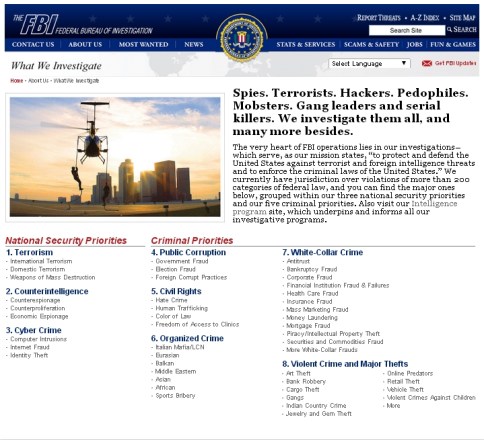
FBI 1

FBI 2

Animal Legal Defence Fund
http://aldf.org/resources/when-you-witness-animal-cruelty/

PETA People for the Ethical Treatment of Animals
To report an animal in imminent danger
http://www.peta.org/about/contact-peta/report-cruelty.aspx
http://www.peta.org/about/contact-peta/email-form.aspx

http://www.peta.org/action/get-active-online/cruelty-internet/#ixzz32rhmJnVw

Check for any specific laws protecting certain species here
http://www.fws.gov/

Wildlife Crime
Traffic – the wildlife trade monitoring network
http://www.traffic.org/home/2014/8/7/landmark-for-wildlife-crime-database-eu-twix.html
Email – traffic@traffic.org
https://www.facebook.com/trafficnetwork?fref=photo

WildLeaks secure whistleblower site for wildlife and forest crime
https://wildleaks.org/

*Kruger National Park Emergency Hotline 013 735 4325 / 013 735 0197 or 076 801 9679.
* Counter poaching hotline: 0800 205 005
* Crime line: SMS 32211 or call 08600 10111
* Customer Care: Email – customercare@sanparks.org or call 012 426 5017

It has come to our attention that there are Websites and Social Media Platforms that are not SANParks official sites that are advocating that incidents in Kruger National Park be reported to them and not to SANParks directly. We therefore request that SANParks be considered as the main contact for reporting incidents. SANParks has other official Social Media platforms apart from Facebook that can be used to report sightings and Incidents as follows:

Twitter Handle – SANParksKNP
Instagram Username – SANParksKNP
(Lesley Nyawoill)

Cleaning Up the Internet
With sites like Myspace and Youtube, please immediately bring any offensive videos to PETA’s attention by emailing us at Info@peta.org.

We require a direct link to the video and to the poster’s web page. Do not post angry comments, and do not complain to the social-networking or video-sharing site about the video, as it might remove the video before PETA has the opportunity to investigate.

As a precaution, please download the video and save the web page/user profile so that PETA can be sure to view both. After our investigation, we will petition the site to remove the video and delete the user’s account.

In cases involving commercial gore and pornography based websites carrying videos of animal abuse for shock purposes, your response will be different. Find the contact address for the website, and identify the website’s internet service provider (ISP). DNSstuff can help you do both.

DNSstuff
Using this site to find contact information for a website is easy. Use the “WHOIS Lookup” option (on the left side of the DNSstuff home page) to perform a search using the domain name. The domain name for PETA’s website, for example, is “PETA.org.” Again, don’t complain directly to the offending site, as this could encourage the site owner. Instead, report it to the appropriate FBI office at http://www.fbi.gov/contact/fo/fo.htm

DNSstuff also makes it easy to find information about the offending website’s Internet service provider (ISP).  First, use the “ping” tool on DNSstuff’s home page to find the IP (Internet Protocol) address for the website; all you have to do is enter the domain name!

Then, enter the IP address into DNSstuff’s “IPWHOIS Lookup” search field, and you’ll get the ISP information! In addition to contacting the ISP representatives directly and explaining to them why the site and/or the offensive files should be removed, ISP information should also be included in your FBI complaint.

Notes
The internet is rife with websites and webpages depicting cruelty to animals. Some sources are educational, depicting the cruel behind-the-scenes reality of industries that thrive on animal exploitation and abuse. Other sources are merely depicting cruelty for shock value. Often, these sites will also carry videos and images that are gory and/or pornographic in nature.

These websites are counting on you to be upset by what you see, inadvertently bringing them more traffic – and consequently more advertising dollars – with your complaints to friends, family, and coworkers. The site owners thrive on your angry messages, often posting them for their sympathetic audiences to enjoy.

Social-networking sites like Myspace and media-sharing sites like Youtube allow users to create their own webpages (in the case of Myspace) and to post blogs, photos, videos, and music. Some people abuse this service by posting videos depicting crimes against animals. Many abusers have been brought to justice after flaunting these crimes online. With your help, abusers can continue to be put behind bars.

Important notes on how and where to report animal cruelty
The Internet delivers an astounding array of images and ideas into homes across the world – but not all of these images are particularly animal-friendly. In the United States, individuals have the constitutional right to free speech, which includes the right to discuss and advocate for animal abuse in public forums like the Internet.

Unfortunately, some of what is being shown online crosses into the realm of illegal activity. Rest assured, animal cruelty is a crime in every state—if people go beyond discussion and actually practice what they preach, they can be prosecuted for animal cruelty under their local laws.

What is a hoax?
While some online images of animal cruelty are, sadly, all too real, many websites that appear, at first glance, to promote animal cruelty are hoaxes. Of course, websites that are disturbing or disgusting are not breaking the law if no animals are actually being harmed. While you can certainly express your opposition to these sites to the companies that host them, be aware that their content can be protected by the First Amendment.

Remember, hoaxes and parodies on the Internet, no matter how offensive, are exempt from cruelty laws.

Where to report
Find out who is responsible for investigating and enforcing the anti-cruelty codes in your town, county and/or state. These people typically work for your local humane organization, animal control agency, taxpayer-funded animal shelter or police precinct.

If you run into trouble finding the correct agency to contact, you should call or visit your local police department and ask for their help in enforcing the law. If your local police department is unable to assist, ask your local shelter or animal control agency for advice.

Reporting online cruelty
This applies to any abuse seen on the internet worldwide, on any site.  Do not protest to Facebook, Youtube, Google, blogging platforms such as WordPress or any other website to “shut down or remove” animal abuse sites, videos or pictures. As none of these sites report animal abuse to law enforcement agencies. The reason for this is that they may shut down the pages or sites, leaving no avenue for the people to be located and arrested and prosecuted, or for the animals to be located and saved.

The main things you must NOT do:

Do not contact the website owner
While it may be mildly therapeutic to tell them what you think of them and their actions, you will be alerting them to their discovery and they may remove the offensive information.

Do not flag the website for removal from a public site
Wherever this is, whether it is on Facebook, MySpace, Twitter, Youtube, Google or others, as that may cause deletion of the pictures or videos, and consequently loss of evidence needed to build a case against the offender.

Do not share the information with others
Other may act in either of the above ways which will lead to loss of necessary evidence. Sharing the website may also increase traffic to the website in question which may support or excite the offender, or even scare him off.

Do not create an online petition
For the same reasons as listed above.

Collect your evidence
Collect as much information as possible. If you are lacking some of the information listed below, you should still share the information that you do have, and a link to the website with the appropriate reporting agency.

Download as much of the information from the website, IE photos, videos, etc. as you can and save them. Print out copies of the offending pages.

Be sure to have as much personal information on the person running the website as possible including, but not limited to, the name, contact information, and location. Try to determine if the offender is within the United States or elsewhere.

Silent Witness
Silent Witness is a non-profit program created to give citizens the opportunity to assist law enforcement in solving crimes. Citizens remain completely anonymous and are paid cash rewards of up to $1,000 when the information they provide leads to an arrest or indictment.

Established in 1979, Silent Witness works in partnership with the community, media and law enforcement, and is a member of both Crime Stoppers USA and Crime Stoppers International

http://silentwitness.org/index.aspx

http://www.americanhumane.org/animals/stop-animal-abuse/fact-sheets/reporting-internet-animal-abuse.html

http://www.humanesociety.org/issues/abuse_neglect/tips/cruelty_action.html#How_to_report_animal_cruelty

http://www.pet-abuse.com/pages/animal_cruelty/reporting_abuse.php

http://www.peta.org/action/get-active-online/cruelty-on-the-internet.aspx

http://www.pet-abuse.com/pages/cruelty_database.php

Facebook page on animal cruelty for advice or other
https://www.facebook.com/pages/Animal-Cruelty-Exposed/363725540304160

Report animal cruelty taking place in a pet store
For concerns about animal cruelty in pet stores, please contact the US Department of Agriculture (USDA). Contact its HQ at (301) 734-7833.

Visit https://www.aphis.usda.gov/wps/portal/aphis/home/ or email ace@aphis.usda.gov. The USDA will direct you to the appropriate regional department to which you will be asked to submit your complaint in writing.

Report cruelty by an animal breeder
For concerns about an animal breeder, please contact the U.S. Department of Agriculture (USDA). You can contact its HQ on (301) 734-7833. Visit https://www.aphis.usda.gov/wps/portal/aphis/home/ or email ace@aphis.usda.gov. The USDA will direct you to the appropriate regional department to which you will be asked to submit your complaint in writing.

The HSUS has established a $5,000 reward program for anyone providing information which leads to the arrest and conviction of animal cruelty in puppy mill operations. All information will be confidential. Please call 1-877-MILL-TIP

Report dog fighting activity (Please note it is now a federal crime to attend a dog fight)
http://politix.topix.com/story/10354-its-now-a-federal-crime-for-you-to-attend-a-dog-fight

Help stop dog fighting
http://www.helpstopdogfighting.com/
http://www.helpstopdogfighting.com/?page_id=17

Report animal hoarding
http://www.animalhoarding.com/

Report acts of cruelty and sexual abuse of animals
http://www.stopcrush.org/?page_id=65
https://www.facebook.com/STOPCRUSH.ORG

Report illegal hunting
Information on hunts, shoots, gamekeepers, where hunts are meeting, places, dates etc., people you suspect of being involved in bloodsports, anybody seen digging for badgers or foxes
http://nottinghamhuntsabs.weebly.com/about-us.html
http://www.nwhsa.org.uk/index.htm

Report poachers in national parks
To the National Parks and Conservation Association on 1-800-628-7275

Report items made from seal products (fur, meat or oil)
CAFT at caft@caft.org.uk

Coalition Against the Fur Trade
http://www.caft.org.uk/

Report wildlife crimes and poaching
https://wildleaks.org

Reporting Violations/Poaching
http://wdfw.wa.gov/enforcement/reporting_violations.htm

To report poaching in progress or dangerous wildlife complaints call 1-800-628-7275
To report non-emergency poaching violations or dangerous wildlife complaints call 1-877-933-9847

Prevention of Cruelty to Animals and Plants Worldwide
Animals without appropriate shelter and either impounding affected animals or issuing citations for violations
If you see an animal at risk call PCAPS on 309-672-2440
http://pcap.amps.org/

Animal cruelty within the UK
The RSPCA (Royal Society for the Prevention of Cruelty to Animals) has a 24 hour hotline available for such incidents. From within the UK, call the cruelty line on 0300 1234 999

League Against Cruel Sports UK Wildlife Crime Reporting Form
http://www.league.org.uk/our-campaigns/hunting-with-dogs/hunting-and-the-law/reporting-illegal-hunting?

Wildlife Crimewatch Line 01483 361 108
Information specifically needed:
– Meet cards for hunts
– Advance warning of any cub (autumn) hunt meets
– Information on individuals who are part of groups/gangs who commit cruelty to animals in the name of sport
– Information on people who attend, organise or travel to hare coursing events
Any information on when and where such events are going to take place

Animal cruelty internationally – how you can help 
WSPA World Society Protection of Animals
http://www.wspa.org.uk/helping/action/

Tactical Team For The Protection of Animals (All Animals T.T.P.A.)
http://m.tacticalteamanimalttpa.org/

It can be very frustrating to be aware of animal welfare issues that don’t seem to be being addressed, but feel helpless to do anything about them.  All is not lost, here are a few things to consider that may help you decide whether something needs to be done, and who by.

Firstly, is another animal welfare organisation working on this issue, but perhaps elsewhere?  Sometimes there is a knock-on effect where a successful project in one locality can be replicated in others.  Even the world’s biggest animal welfare organisations cannot address every issue there is, and have to focus where they can effect the greatest change.  We would recommend supporting their efforts, even if they haven’t reached your locality yet.

Are there local organisations working on other animal welfare issues, or on animal welfare generally?  Sometimes it is more effective to take a general approach to animal welfare by addressing some of the larger or more widely-spread issues thus establishing an interest among the local community and the authorities in improving animal welfare.  This might not solve the problem you see right in front of right now, but it might be necessary to achieve this before being able to address the issue you’re concerned about at all.  We would recommend supporting your local animal welfare groups.

Who has the power to change things?  Sometimes the issue you are concerned about is illegal or contrary to local cultural values.  Even if it is not, you may still wish to object.  We would recommend reporting your concerns to the relevant local authority.  Please remember to be polite and concise, to refer to the animal welfare concern directly.  Justify your objection with scientific reasoning and propose an effective and ethical alternative or solution. There are many helpful links on the Welcome page of this blog site.

How do I access resources to back me up?  There are plenty of resources to support all kinds of animal welfare concern and we would encourage you to reference animal welfare successes in other areas, reports from animal welfare organisations and recommend animal welfare guides where appropriate.  You can find these by contacting relevant animal welfare organisations or visiting websites that contain expert advice.

International Companion Animal Management Coalition
For resources relating to stray dog population management in several different languages http://icam-coalition.org/resources.html

World Animal Net Useful Links
Contains listings of over 17,000 animal welfare (and related) societies in more than 170 countries http://worldanimal.net/useful-links

WSPA search animal welfare organisations
Review animal welfare standards worldwide using the Animal Protection Index http://www.worldanimalprotection.org/our-work/help-protect-animals-globally

To report bogus charities and internet fraud scams in the UK
http://www.actionfraud.police.uk/

Trophy Hunting and Hunters Exposed MP3s

[audio https://endtrophyhuntingnow.com/wp-content/uploads/2014/02/the-big-questions.mp3|titles=on Trophy Hunting|artists=The Big Questions BBC1|animation=no|remaining=yes|initialvolume=72|width=355]

This debate on Trophy Hunting begins about halfway through, the first half being abuse in the Catholic church.

These are both DEFINITELY worth listening to:

Destination of Trophy Hunters GIF Story

382koteczek

original        abutterflower

apenguins       asnoopytophat         butterfly             blackcat bird

ku-medium (1)

Cat fights back   catcatblink  CatSleeping

catnaughty   arosebud

kitty-4

Cats fight back 2

MiscPC             pc-crash

Image-1-2

clapclapping

deerpopcorn  penguinrosedancing

tiger

lion-1

impuss

chuck

truck

policecar        moneysealion

xzuvlqw

DogjumpropeDolphins in Denmark

duck-2  

happy

puppy-1

birdhumparrots

imdaisiesandbee

imroses   roseblackimroseyellowdaisyflowerplant

goldstars

KJV

moonwalk

panda-2


racoon-1

racoon-2

racoon-3  

stumble  

Wolf cub

catcomputer3

THE DESTINATION OF TROPHY HUNTERS

eye

snoopytophat

emailgoodone

Barbaric Practices of Recreational Hunting

Although it was a crucial part of humans’ survival many thousands of years ago, hunting is now nothing more than a violent form of recreation that the vast majority of hunters do not need for subsistence.

Hunting has contributed to the extinction of massive numbers of animal species and sub-species all over the world, such as three of the nine sub-species of tiger, so that now it is estimated that apart from those in captivity due to tiger farming by the Chinese and Vietnamese, there are now only around 3,000 tigers of all six remaining sub-species left in the wild.

For example, in recent times, there were five rhino species represented by 13 subspecies. Three of the subspecies are now extinct, two others (Ceratotherium simum cottoni and Dicerorhinus sumatrensis harrisoni) are perilously close to extinction, and one (Dicerorhinus sumatrensis lasiotis) may already be extinct, despite unconfirmed reports of its continued existence.

Recent figures for rhino species and subspecies are:

1. Northern white rhinoceros [Ceratotherium s. cottoni]
Southern white rhinoceros [Ceratotherium s. simum] 20,405
http://www.rhinos.org/species/white-rhino/

2. Southwestern black rhinoceros [Diceros bicornis] 1,900
Western black rhinoceros [Diceros b. bicornis longipes]  0
Southern black rhinoceros [Diceros b. bicornis minor] 2,200
Eastern black rhinoceros [Diceros bicornis michaeli] 750
http://www.rhinos.org/species/black-rhino/

3. Indian rhinoceros [Rhinoceros unicornis]  (in 2007) 2,575
aka Greater one-horned rhinoceros
http://www.rhinos.org/species/greater-one-horned-rhino/

4. Javan rhinoceros
Rhinoceros sondaicus sondaicus 60
Rhinoceros sondaicus annamiticus 0
Rhinoceros sondaicus inermis 0
http://www.rhinos.org/species/javan-rhino/

5. Sumatran rhinoceros
Dicerorhinus sumatrensis lasiotis 0 (unconfirmed)
Dicerorhinus sumatrensis harrisoni 30
Dicerorhinus sumatrensis sumnatrensis 220
http://www.rhinos.org/species/sumatran-rhino/

Despite these low numbers rhino 1004 were poached last year and 172 up to mid March 2014.  Poaching though is not the only reason numbers have dwindled to such a critically low number, as in recent years many rhino have also been legally hunted and killed.

In a practice called trophy hunting, it is still possible to legally hunt lions, leopards and other big cats, elephants, rhino, giraffes, hippos, and any number of deer and antelope by buying a permit at a Safari Club International auction, for example, or online from various hunting organisations.    It is also possible to kill rare animals.  The rarer the animal the higher the price ‘hunters’ will pay for the permit to kill one.

There are various different types of trophy hunters.  There are those who just kill wildlife such as cats, bears, wolves, deer, raccoons, duck, whatever.   Some of them are competitive about how many they kill and the size of the antlers, etc. others just go hunting as a hobby at weekends and typically go on hunting holidays.

Then there is a large comparatively sophisticated group of wealthy trophy hunters who travel to compete for various awards by killing certain numbers of animals of particular species in different countries and on all five continents.

There are many different types of awards which are organised by the Safari Club International (SCI).  The SCI is an international organization with more than 50,000 members and 180 local chapters.  The SCI is dedicated to protecting the freedom to hunt and – they say “promoting wildlife conservation”.

Less than 5 percent of the US population  – about 13.7 million people – hunt.  Yet hunting is permitted in many wildlife refuges, national forests, and state parks and on other public lands. Almost 40 percent of hunters slaughter and maim millions of animals on public land every year, and by some estimates, poachers kill just as many animals illegally.

Pain and Suffering

Many animals endure prolonged, painful deaths when they are injured but not killed by hunters. A study of 80 radio-collared white-tailed deer found that of the 22 deer who had been shot with “traditional archery equipment,” 11 were wounded but not recovered by hunters.  Twenty percent of foxes who have been wounded by hunters are shot again. Just 10 percent manage to escape, but “starvation is a likely fate” for them, according to one veterinarian.  A South Dakota Department of Game, Fish and Parks biologist estimates that more than 3 million wounded ducks go “unretrieved” every year.

A British study of deer hunting found that 11 percent of deer who’d been killed by hunters died only after being shot two or more times and that some wounded deer suffered for more than 15 minutes before dying.  Other studies in the US have also shown that half or more of the deer who are shot are not killed, and can live for days, weeks or months afterwards, and so die long and painful deaths.

Hunting disrupts migration and hibernation patterns and destroys families. For animals such as wolves, who mate for life and live in close-knit family units, hunting can devastate entire communities. The stress that hunted animals suffer—caused by fear and the inescapable loud noises and other commotion that hunters create—also severely compromises their normal eating habits, making it hard for them to store the fat and energy that they need in order to survive the winter.

Nature Takes Care of Its Own

The delicate balance of ecosystems ensures their survival —if they are left unaltered. Natural predators help maintain this balance by killing only the sickest and weakest individuals. Hunters, however, kill any animal whose head they would like to hang over the fireplace—including large, healthy animals who are needed to keep the population strong. Elephant poaching is believed to have increased the number of tuskless animals in Africa, and in Canada, hunting has caused bighorn sheep’s horn size to fall by 25 percent in the last 40 years. Nature magazine reports that “the effect on the populations’ genetics is probably deeper”.

Even when unusual natural occurrences cause overpopulation, natural processes work to stabilize the group. Starvation and disease can be tragic, but they are nature’s ways of ensuring that healthy, strong animals survive and maintain the strength of the rest of their herd or group. Shooting an animal because he or she might starve or get sick is arbitrary and destructive.

Another problem with hunting involves the introduction of exotic “game” animals who, if they’re able to escape and thrive, pose a threat to native wildlife and established ecosystems.

Canned Cruelty

Most hunting occurs on private land, where laws that protect wildlife are often inapplicable or difficult to enforce. On private lands that are set up as for-profit hunting reserves or game ranches, hunters can pay to kill native and exotic species in “canned hunts.” These animals may be native to the area, raised elsewhere and brought in, or purchased from individuals who are trafficking in unwanted or surplus animals from zoos and circuses. The animals are hunted and killed for the sole purpose of providing hunters with a “trophy.”

Canned hunts are big business—there are an estimated 1,000 game preserves in the U.S., with some 5,000 so-called “exotic ranchers” in North America. Ted Turner, the country’s largest private landowner, allows hunters to pay thousands of dollars to kill bison, deer, African antelopes, and turkeys on his 2 million acres.

Animals on canned-hunting ranches are often accustomed to humans and are usually unable to escape from the enclosures that they are confined to, which range in size from just a few yards to thousands of acres. Most of these ranches operate on a “no-kill, no-pay” policy, so it is in owners’ best interests to ensure that clients get what they came for. Owners do this by offering guides who are familiar with animals’ locations and habits, permitting the use of dogs, and supplying “feeding stations” that lure unsuspecting animals to food while hunters lie in wait.

While many states have limited or banned canned hunts, there are no federal laws regulating this cruel practice at this time.

Other Victims

Hunting accidents destroy property and injure or kill horses, cows, dogs, cats, hikers, and other hunters. In 2006, then–Vice President Dick Cheney famously shot a friend while hunting quail on a canned hunting preserve. According to the National Shooting Sports Foundation, thousands of injuries are attributed to hunting in the U.S. every year—and that number only includes incidents involving humans.

The bears, cougars, caracals, and bob cats, deer, foxes, and other animals who are chased, trapped, and even killed by dogs during – sometimes illegal – hunts aren’t the only ones to suffer from this variant of the “sport.”  Dogs used for hunting are often kept chained or penned and are denied routine veterinary care such as vaccines and heartworm medication. Some are lost during hunts and never found, whereas others are turned loose at the end of hunting season to fend for themselves and die of starvation or get struck by vehicles.

The widespread cruel practice of canned hunting of lions

There are few wild lions left in Africa, and just about all hunting of lions is of specially bred lions in a practice called “canned hunting”.  This is often ressed up to look more authentic, with so-called ‘hunts’ being staged by companies who will, for example, pretend to ‘search’ for the lion when they know where it will be as it was put there just a few days ago in a large enclosure, alone for the first time in its short life.  Sometimes the animals are drugged beforehand.  The ‘hunters’ are often bad shots, and take several shots to kill the animals which can suffer quite badly in the process.   There are videos on Youtube which clearly show this to be the case and are quite difficult to watch.

Lions - For sale killing

The hunting of the bred lions is not the only reason for complete rejection of this industry as being unethical from the point of view of animal protection. The road to suffering for the lions on the South African breeding farms begins shortly after their birth.

Separated from the mother too soon

Often the lion cubs are separated from their mothers only three days after their birth. This practice has often fatal consequences, not including the mental suffering that these animals suffer: Due to the lack of milk provided by the mother, multiple deficiencies are displayed in the young animals. The cubs frequently suffer from bone deformations, breathing and digestive problems, thyroid problems, calcium deficiencies, tuberculosis and many other illnesses, the results of which have a significant effect on the animals when they grow up.

The keeping conditions for the young animals are also often completely unacceptable: Water, food and shade are hard to come by in many of the cages. In the some cases, female cubs are shot shortly after their birth as they are rarely in demand for hunting.

Patting is stress

Even when they are only babies, the little lion cubs are abused as tourist attractions. They are raised by hand, so tourists can be charged to pet them or when they get older, walk with them. Everywhere in South Africa you can find the offers to pat a lion cub, take your photo with a lion cub or to go for a walk with a half grown lion.

This is pure stress for the motherless lion cubs: young animals have a great need for calm and so the constant contact to people and the bad keeping conditions lead to massive behavioural disturbances. Even their physical development is strongly affected. In addition, more and more people are being attacked and injured by young lions.

Lionesses as breeding machines

The breeding lionesses are in heat again very shortly after their young cubs are taken away from them and are then instantly mated again. Abused as “breeding machines”, continuously exposed to the traumatic experience of losing their young. Because they are giving birth much more often than they would be doing under natural conditions, after only a few years they become drained and weak. The cubs that are bred to these lionesses while they are in this condition also have a bad constitutions.

In the wild, lionesses usually give birth once every two years – on the breeding farms they have to give birth every six months. It is not rare for drained or small lionesses to end up being “special offers” for hunters.

Misinformation for tourists …

The lion breeders falsely describe themselves as “nature protectionists” and claim to tourists that the animals are being bred to be later released into the wild. This is obvious misinformation. Predators that are born in captivity, especially when they have been raised by hand, cannot be successfully released into the wild.

… and volunteers

Voluntary workers from Europe are often attracted to the breeding farms as volunteers, to work together with the farms to breed lions. It’s not rare for these volunteers to pay a lot of money for a six week stay in a so-called “rescue station” or a “game reserve”.

However these offers have nothing to do with the protection of species or animals. The young lions suffer on these farms. Anyone doing volunteer work or gaining work experience here is supporting the horrific lion industry – even if they don’t intend to or realize that they are doing so.

As a general rule, the sad end destination of a South African breeding lion is a Canned Hunting farm.

Please read this short but well-written article to see how badly lions suffer in this process, as the mothers cry for their cubs who are in turn crying for them, for many months, usually within hearing distance of each other.

Sanwild Lion Rescue on  the Exploitation of Lions

Cruel Louisiana Hunter Gored by Wounded Buck

While of course it is regrettable this hunter was seriously wounded, typically of so many hunters – where half the animals shot are not killed only wounded – his own account shows that he has little or no regard for the suffering of the animals he shoots:

On Christmas Eve last year 2013 Louisiana hunter Bobby Neames shot a big 6-point buck before even climbing his stand. But 15 minutes later the buck charged, and Neames found himself fighting for his life.  The 46-year-old hunter set out the morning before Christmas in East Feliciana Parish, La., reports the Louisana Sportsman. Neames was expecting company for lunch and still had cooking to do, but the rut peaked on Christmas and he could not resist a quick hunt.

[Editor: Hardly normal behaviour not to be able to resist going hunting when you are imminently expecting guests for lunch.  Surely evidence that this man was gripped by the addictive bloodlust that drives some of these people to kill many hundreds of deer, wolves, foxes and raccoons, etc. in the course of one year?]

Neames walked just 400 yards from his home to his hunting spot. As he approached the food plot near his box stand, he stopped in a shooting lane to scan the field. He spotted a 6-point eating rice bran from a feeder 75 yards away. Neames recognized the deer as a buck he’d been hunting for three years, although this was the first time he encountered it during daylight.

But the bruiser saw Neames at the field’s edge and took off toward a thicket. Neames back-pedalled and dropped to one knee, raising his .270 Winchester. He aimed for its neck, the only shot available, and squeezed the trigger. The buck made it just 20 yards along a main trail before Neames heard it crash.

Neames said he usually waits 45 minutes before recovering a deer. But he felt pressed for time and was confident in his shot, so instead he set off to retrieve the buck after waiting just 15 minutes.

“Usually with a neck shot they’d fall right there, but being he didn’t run but 20 yards and I never heard anything else, I walked on over there,” Neames told Louisiana Sportsman. “I was probably just too anxious. That’s maybe one of the mistakes I made, not giving him enough time. But I never heard him kicking anymore, and I just figured he was dead.”

Neames chambered a second bullet before following. He walked along the trail, stopping 20 feet away when he spotted the buck. It lay on the ground, leaning over its two front legs. He noticed the shot had clearly missed the bone to hit just below the white patch. The buck was facing the opposite direction it had fled, which meant he was facing directly toward Neames. Then the hunter and the buck made eye contact.

Even with his finger on the trigger, Neames didn’t have a chance to react. He said the buck leapt forward from the ground, its hooves never touching the dirt until it reached him. “I do remember thinking, ‘I can’t believe this deer is jumping like this,’” Neames told the website. “It’s amazing how much you can think in thousandths of a second.”

The buck drove his antlers into Neames’ right thigh and flung him. “When he picked me up and threw me, I felt it just rip,” he said. “I knew I was hurt bad because I felt it rip my leg open. He threw me like I was nothing.”

He landed with a 7-inch gash in his thigh and without his gun. The buck snagged the strap when it charged and the rifle was now tangled in its antlers. The buck didn’t seem to notice, and charged Neames again as he lay on the ground.

“He’s fighting me and I remember the gun hitting me in the head and slinging around. I remember thinking if he don’t kill me, the damn gun will go off and shoot me. I was scared to death because I knew it was off safety.”

Neames struggled with the buck for several minutes. At 6-feet tall and 240 pounds, Neames said his size saved him. He was able to hold the buck off for a bit, but he was still trapped on the ground.

“All I could do was try to grab his horns every time he came down at me. If my hands would have slipped off one time, he’d have just rammed the horns through my chest,” Neames told the website. “I knew I had to protect my lungs, my heart and my face. But I was on my back and I couldn’t get to my feet.”

As the buck made another charge, Neames seized its antlers. “The last time he came at me, something told me to just twist his neck like you’d bulldog a steer,” he said. “I twisted his neck and he did a complete flip all the way over me.”

The buck crashed. Its antlers caught on the ground for a few seconds, giving Neames a chance to scramble away. He made it just 8 feet, but it was far enough.

The buck looked at him and fled with the rifle still in its antlers.

Neames’ son later found the dented rifle covered in blood 30 yards down the path.

Neames successfully fought off the buck, but now he faced a 400-yard hike uphill to his house. He didn’t think he would get that far, but somehow made it to his back patio before collapsing. His 21-year-old daughter found him covered in blood and thought his rifle misfired. She dialed 911 and a helicopter airlifted him to Baton Rouge.

The medical staff was unsure if Neames had suffered internal injuries and he underwent 90 minutes of emergency surgery. In addition to the 7-inch gash in his thigh, doctors discovered the buck’s antler had gouged a further 7-inches below the surface. But apart from a few other cuts Neames sustained no broken bones or internal injuries. He returned home late on Christmas Eve with 23 staples and multiple stitches in his thigh.

Neames has hunted for 33 years and he didn’t let the accident stop him from hunting again in January. “It was just a freak thing that happened. He was just doing what was natural to him, trying to survive,” Neames told the website.

Despite the trauma of the attack, Neames said the worst part of the whole incident was losing the buck. No one has seen the deer since the attack and he suspects it didn’t survive. But he hopes it recovered–he wants a second chance to take the buck next season.

by Natalie Krebs